If you are working in the healthcare field, you must hear a work clean claim many times, whether in a billing meeting or during revenue cycle discussions. But have you ever tried to know the actual meaning of this term and why it is required by all healthcare practices?
If not, then you are missing a great opportunity, as submitting clean claims is one of the simplest yet most powerful ways to improve reimbursement rates, reduce denials, and keep your revenue cycle running smoothly.
So let’s understand what clean claims are and how they impact reimbursement, and what you need to do to achieve higher clean claim rates.
What Is a Clean Claim?
Clean Claim Definition: A clean claim is a healthcare claim that’s submitted to a payer with zero errors, complete information, and full compliance with that payer’s requirements, right on the first try. No missing fields, no mismatched codes, no expired authorizations. Just a claim that smoothly gets paid.
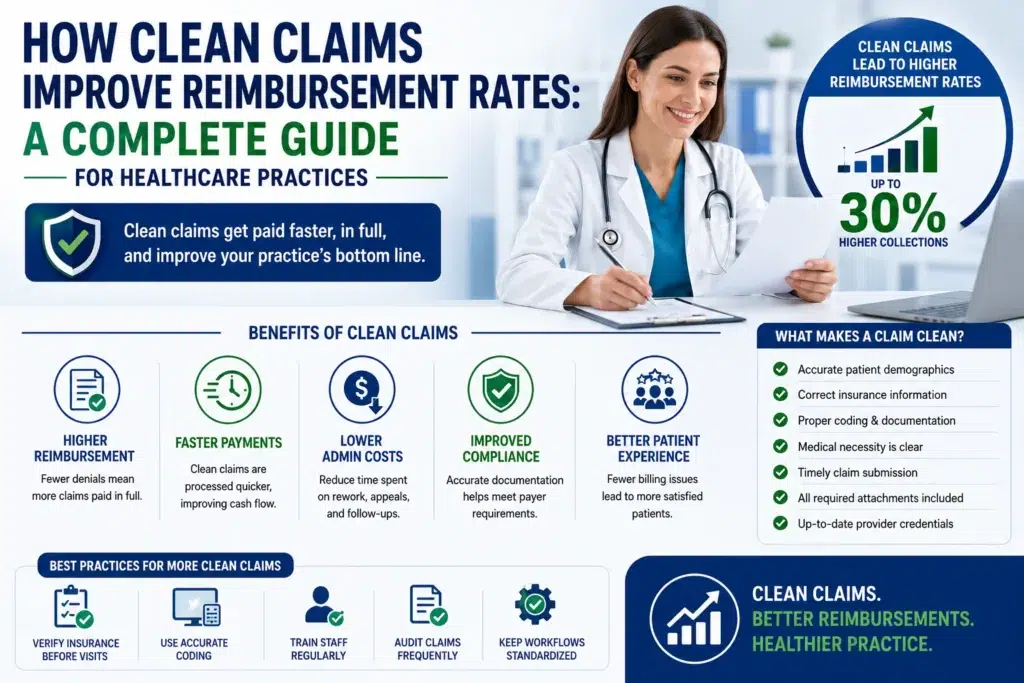
As its name shows, clean claims means a medical insurance claim that’s complete, accurate, and free from errors when it’s submitted to the payer. A clean claim includes:
- Accurate patient demographics
- Verified insurance information
- Correct CPT, HCPCS, and ICD-10 codes
- Proper modifiers
- Valid National Provider Identifier (NPI)
- Complete documentation
- Medical necessity support
- Correct billing format
- Required prior authorization when applicable
When a payer receives a clean claim, it usually doesn’t require additional information or manual review. That means it processes much faster. The rate of clean claims is calculated as the sum of clean claims divided by the total number of claims submitted. For example, if 92 claims out of 100 are submitted the first time, the clean claim rate becomes 92%.
The Direct Link Between Clean Claims and Reimbursement Rates
Clean claims don’t just affect whether you get paid, they affect how much and how fast.
When a claim is denied and has to go through appeals, it takes weeks or months longer to collect. During that time, cash flow became slow. Some denied claims never get resubmitted at all. Studies show that up to 65% of denied claims are never appealed, which means that revenue is simply lost permanently.
On the other side, a high clean claim rate (CCR) creates a positive financial cycle for your practice:
- Faster payments. Claims that are clear on the first pass get processed and paid more quickly than those requiring rework.
- Improved cash flow. Predictable reimbursements let you plan expenses, payroll, and growth with confidence.
- Lower administrative costs. Every denied claim costs your team time that they spent researching the denial, correcting errors, resubmitting, and following up. Eliminating those denials frees your staff to do more valuable work.
- Stronger payer relationships. Consistently clean submissions signal to payers that you’re a reliable and professional practice. That reputation helps during contract negotiations.
The industry benchmark for a healthy, clean claim rate is 95% or higher. Top-performing organizations using the right tools and processes can push that to 98% or even higher. The gap between a 90% CCR and a 98% CCR seems very small, but on hundreds or thousands of claims per month, that difference means tens of thousands of dollars in recovered revenue.
The Most Common Reasons Claims Aren't Clean
Before you can fix the problem, you need to understand where it starts. Most dirty claims, known as rejected or denied claims, happen due to recurring issues, including:
Eligibility and Coverage Errors
A patient’s insurance can have changed, lapsed, or the service can simply not be covered under their current plan. Verifying eligibility once at the time of scheduling isn’t enough because coverage can change between the appointment and the date of service.
So must verify eligibility in real time at scheduling, then again at check-in.
Incorrect or Outdated Coding
Coding errors also highly contribute to denials, including the use of wrong ICD-10, CPT, or HCPCS codes, missing required modifiers, using outdated codes after annual updates, or applying a diagnosis code that doesn’t match the procedure billed. That’s why regular training and audits are necessary.
Missing or Incomplete Patient Demographics
A name spelled differently, a mismatched date of birth, and an incorrect member ID. These seem like minor clerical errors but to an insurance payer’s automated system, they become a reason for denial. Front desk services should focus on it.
Prior Authorization Problems
Submitting a claim without a required authorization or entering the authorization number incorrectly is a reason for denial. To reduce this, try to create a service-specific authorization matrix by payer and set reminders.
Documentation Gaps
Even when the coding is right, missing documentation can cause denial. Operative notes that weren’t attached, missing provider signatures, or inadequate support for medical necessity are common issues.
Practical Strategies to Improve Your Clean Claim Rate
The revenue cycle management of one practice depends on the quality of the claim. Knowing the problems is one thing but how to fix and recover them is the major step. Let’s show you how high-performing practices actually fix them.
Start at the Front Desk
The clean claim process starts before even clinical work happens. Front desk staff here play an important role in collecting the right information, verifying insurance, and capturing the right authorization information. Train front desk teams to verify information at every visit, not just new patient encounters.
For more accuracy, use electronic verification systems that cross-check patient data against insurance records in real time. Capture photos of insurance cards (front and back) at each appointment.
Implement Claim Scrubbing Software
Claim scrubbing tools review your claims line by line before submission, catching errors that human reviewers would miss. It is just like a spell-checker for your billing system that helps to find missing fields, code mismatches, payer-specific rule violations, and hundreds of other potential issues before the claim submission. This single step has a huge impact on your CCR.
Follow Payer-Specific Guidelines
All insurance companies have their own rules. Medicare can accept those requirements that other commercial payers cannot. Then all payers have different local coverage determinations, modifier requirements, and documentation standards. So you have to work according to the payer’s requirements. Create payer-specific billing guides for the top payers your practice works with. Revisit those guides whenever you receive a denial pattern from a particular payer. It helps to get updated with the latest rules you don’t know about.
Monitor Denial Trends
If your practice is consistently facing denials, then instead of fixing claims one by one, identify patterns and recurring issues.
Ask questions like:
- Which payer generates the most denials?
- Which providers have the highest error rates?
- Which CPT codes are frequently rejected?
Fixing recurring issues produces lasting improvements.
Keep Your Chargemaster Current
The chargemaster is your practice’s master list of service fees and associated billing codes. It needs to be updated regularly to reflect CMS fee schedule changes, new procedures, and annual code updates. An outdated chargemaster is a quiet but costly source of billing errors.
Build a Culture of Accountability
Clean claims aren’t just a billing department problem. They’re a whole-practice responsibility. Physicians who document thoroughly, coders who stay current, and front desk staff who verify carefully, everyone plays their own role.
That’s why it is important to consider regular internal audits, team-wide training on common denial reasons, and sharing clean claim rate metrics across departments.
When the full team understands how their work affects reimbursements, they all work to improve documentation and coding to increase the clean claim rate.
How M&M Claims Care Helps Practices Submit Cleaner Claims
Another way to keep your clean claim rate higher is to outsource medical billing services.
At M&M Claims Care, we understand that denials mean delayed revenue and extra work for your team. That’s why our medical billing specialists focus on getting claims right the first time. We have been working, serving revenue cycle management services to US healthcare providers for years. And we are successful in maintaining a 98% first pass clean claim rate.
We know how to combine experienced billing professionals with proven workflows and provide you with a healthier cash flow so you can run your practice successfully.
Without wasting your time on claim denials, contact us at +1 (267) 768-7915 and leave all your headaches on us.