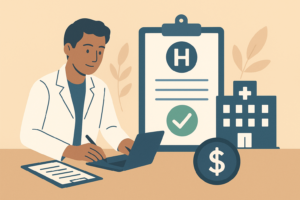
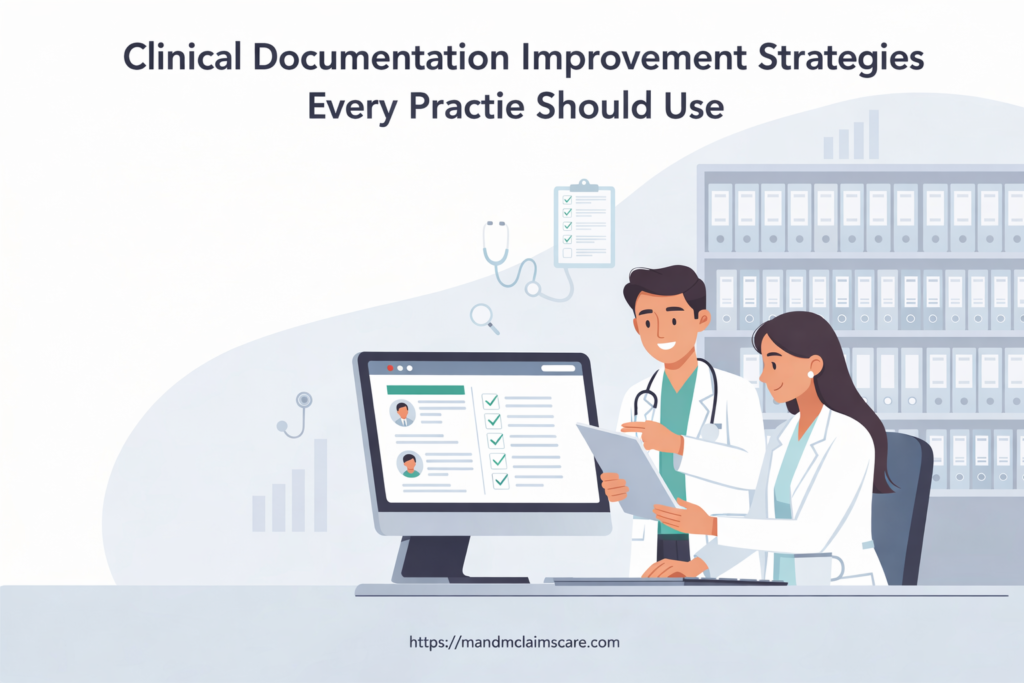
Clinical documentation is an important aspect of healthcare practices. It includes everything from patient care and compliance reimbursement, long-term practice success, and even how smoothly your front desk and billing teams can perform their jobs. That’s why clinical documentation improvement (CDI) has become more important. It helps to ensure accuracy and measure the effectiveness of treatment. When documentation is strong, everything else in your practice falls into place. When it’s weak or inconsistent, problems start quickly.
But the good thing is that most of these issues are preventable with the right strategies.
That’s why practices invest in the best medical billing companies like M&M Claims Care to make their documentation accurate.
So let’s discuss the practical clinical documentation improvement strategies that every healthcare practice should be using for smooth revenue cycle management.
What Is Clinical Documentation Improvement (CDI)?
Clinical Documentation Improvement (CDI) is the process of making sure that medical records are accurate, complete, specific, and reflective of the patient’s true condition and care provided. It includes all the information about what was actually done, why it was done, and how complex the patient’s condition truly was. You don’t need to write long notes but writing better matters the most. Good documentation tells the full patient story. Great documentation also helps in billing to support:
- Accurate medical coding
- Clean claims submission
- Proper reimbursement
- Regulatory compliance
- Better continuity of care
CDI is not to add unnecessary detail but it’s about clarity, specificity, and consistency. When documentation tells the full clinical story, coders don’t have to guess, billers don’t have to chase corrections, and providers don’t have to deal with constant interruptions.
Why Clinical Documentation Improvement Is No Longer Optional
Many practices underestimate how much weak documentation affects their revenue cycle management. A missing detail here or an unclear diagnosis does not seem like a big deal but to insurance companies, it’s enough to deny or downcode a claim. Common consequences of poor clinical documentation include:
- Increased claim denials
- Downcoding or underpayment
- Delayed reimbursements
- Higher audit risk
- Provider burnout
- Frustrated billing teams
On the flip side, improving documentation isn’t just a step for compliance but it’s a business decision. Practices that prioritize clinical documentation improvement in medical billing often experience:
- Faster claim approvals
- Fewer payer queries
- Improved cash flow
- Stronger compliance posture
- Better patient outcomes
Strategy #1: Document for Accuracy, Not Just Speed
Providers are most of the time busy. So the notes are often written quickly between patients or at the end of a long day. But this quick documentation usually leads to missing details that matter later.
Instead of focusing on speed and documenting diagnosis only, aim for documenting the patient’s story accurately and completely the first time. That means clearly documenting:
- What is patient-relevant history
- What symptoms did the patient present with
- How severe or persistent those symptoms are
- What clinical reasoning led to the diagnosis
- Why the chosen treatment was appropriate
This kind of documentation doesn’t just help coders but it makes claims stronger and easier to defend if questioned by payers.
Strategy #2: Be Specific—Vague Documentation Is a Claim Denial Magnet
Specificity is one of the biggest drivers of successful CDI. Let’s compare these two examples:
“The patient has diabetes.”
“Patient has Type 2 diabetes mellitus with diabetic neuropathy, uncontrolled.”
That level of detail impacts:
- ICD-10 code selection
- Risk adjustment
- Reimbursement accuracy
- Quality reporting
Encourage providers to document:
- Severity
- Laterality
- Acuity
- Cause-and-effect relationships
- Complications and comorbidities
The more specific the documentation, the easier it is to assign accurate codes and justify reimbursement. Specificity also helps track chronic conditions more effectively, which is especially important for risk adjustment and value-based care models.
Strategy #3: Clearly Show Medical Necessity in Every Note
One of the most common reasons claims get denied is lack of medical necessity, and it almost always comes back to documentation.
Payers want to see:
- Why the patient needed care at that time
- Why the service or procedure was appropriate
- Why the level of care matched the patient’s condition
Your documentation should clearly link:
- Symptoms, Diagnosis, Treatment, Outcome
When documentation leaves these questions unanswered, payers are quick to reject claims even if the service itself was completely justified.
Strategy #4: Standardize Documentation Without Turning Notes Into Templates
Templates and EHR shortcuts can be helpful, but overusing them can affect more than help. Notes that look identical from visit to visit can be doubted by auditors and don’t accurately reflect patient-specific care. The goal is standardization with flexibility.
Standardized clinical documentation best practices include:
- Specialty-specific templates
- Using prompts instead of pre-filled text
- Customizing notes for each encounter
- Removing irrelevant or outdated information
Good CDI balances efficiency with authenticity. Each note should stand on its own and reflect the individual patient’s condition and care.
Strategy #5: Improve Provider Education Without Overwhelming Them
Most documentation issues aren’t caused intentionally; they come from a lack of clarity around what payers actually expect. Providers are busy, and documentation rules change frequently. That’s why ongoing and targeted education is a powerful CDI tool.
Effective education focuses on:
- Common denial reasons
- Documentation requirements for high-risk services
- E/M documentation guidelines
- Specialty-specific ICD-10 tips
Short and focused feedback works far better than long training sessions. When providers understand why documentation matters, improvement happens naturally.
Strategy #6: Use Concurrent Documentation Review
Waiting weeks or months to review documentation often leads to vague answers or missed details. That’s why concurrent or near-real-time documentation review is so effective.
Concurrent documentation review means:
- Reviewing notes close to the time of service
- Identifying missing elements early
- Querying providers while details are still fresh
This proactive CDI approach helps:
- Reduce rework
- Speed up billing
- Improve documentation habits over time
It’s one of the most effective ways to improve documentation quality without increasing provider burden.
Strategy #7: Use Compliant Provider Queries to Clarify Documentation
When documentation is unclear, assumptions can be risky. A structured provider query allows clarification without compromising compliance.
Implement a query process that:
- Is compliant
- Is non-leading
- Clearly explains what’s missing
- Allows providers to clarify intent
Well-written queries protect:
- Coding accuracy
- Audit defensibility
- Clinical integrity
Strategy #8: Align Clinical Documentation With Coding and Billing Teams
One of the biggest mistakes practices make is treating documentation, coding, and billing as separate work. In reality, they are deeply connected.
Strong CDI programs encourage:
- Regular communication between providers and coders
- Feedback loops on documentation issues
- Shared understanding of payer trends
- Collaboration instead of blame
When everyone’s aligned and works towards the same goal, documentation improves naturally, and revenue also.
Strategy #9: Perform Regular Internal Documentation Audits
Internal audits are one of the most overlooked CDI strategies in healthcare, yet they’re actually incredibly effective. Reviewing documentation internally allows practices to find patterns before payers do.
Routine documentation audits help identify:
- Missing or weak documentation patterns
- Specialty-specific risks
- Training opportunities
- Compliance gaps
By catching issues internally, you stay ahead of:
- Payer audits
- Recoupments
- Compliance penalties
Audits are just like maintenance for your revenue cycle that keeps small issues from turning into big problems.
Strategy #10: Leverage Technology—But Don’t Rely on It Blindly
Technology can be powerful and enhance CDI, but it is not magic that can replace clinical judgment. EHR tools, voice recognition software, and CDI alerts work best when they support thoughtful documentation.
Technology should:
- Support medical billing documentation accuracy
- Reduce repetitive tasks
- Prompt required elements
- Improve workflow efficiency
The best results come from combining smart technology with educated providers and experienced billing teams.
Strategy #11: Focus on High-Impact Areas First
Trying to improve documentation across every service at once can feel overwhelming. A more effective approach is to start with areas that have the biggest impact.
High-impact areas often include:
- Evaluation and Management (E/M) services
- Chronic condition documentation
- Risk-adjusted diagnoses
- Procedures with high denial rates
Improving documentation in just a few key areas can lead to noticeable revenue improvement quickly.
Strategy #12: Make Documentation a Habit, Not a Burden
The most successful CDI programs don’t rely on constant reminders or corrections. They build good documentation habits.
That happens when:
- Expectations are clear
- Feedback is constructive
- Providers see real results
- Billing headaches decrease
When documentation improves, providers actually spend less time dealing with billing issues.
How M&M Claims Care Helps Practices Improve Clinical Documentation
M&M Claims Care is a professional medical billing company that has been working for years to serve different practices. With a skilled team of professionals, we understand that the documentation challenges vary by specialty, payer mix, and workflow. Our CDI in revenue cycle management support:
- Documentation reviews and gap analysis
- Coding and documentation alignment
- Provider education and feedback
- Denial trend analysis
- Ongoing billing and compliance support
Our goal is to help your practice document accurately, bill confidently, and get paid faster without adding stress to your team.