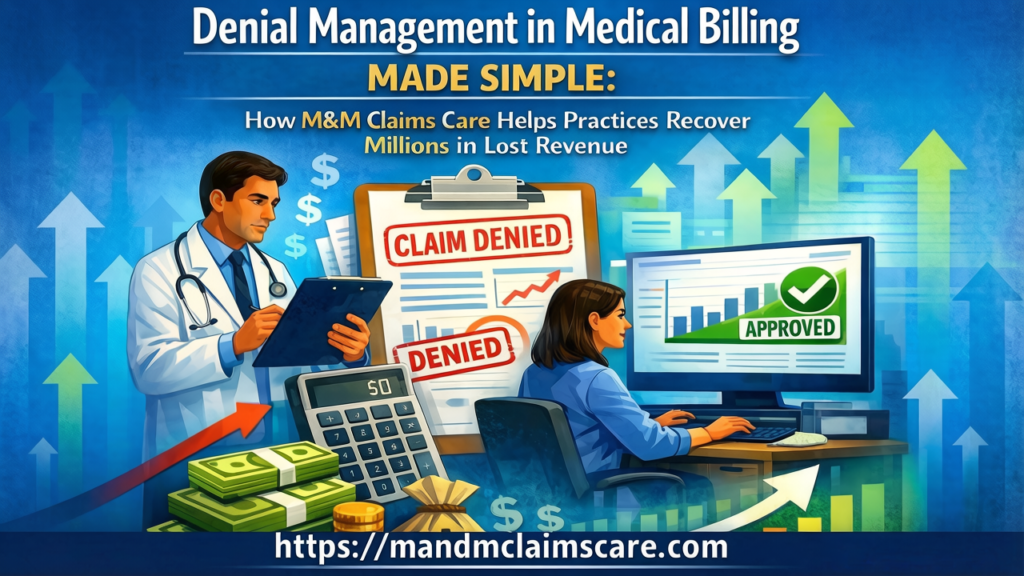
When your practice works best, claims are submitted on time, payments are coming but the revenue graph is still the same. What should be the reason? The major and secret thing behind this can be a claim denial. And denials are common in medical billing due to a small error or sometimes due to complexity. Either way, it slows down your cash flow, consumes staff time, and quietly drains your revenue. And the most alarming thing is that a large portion of denied claims are never reworked or appealed. That’s why it’s become a serious financial issue for healthcare practices.
This makes denial management a crucial aspect of medical billing processes. Efficient denial management has become one of the most powerful tools to recover lost revenue, improve billing accuracy, and strengthen your financial performance.
Let’s discuss in detail what denial management in medical billing is and how smart practices are using expert support to recover millions they didn’t even realize they were losing.
What Is Denial Management in Medical Billing?
Denial management is the process of:
- Identifying why claims are denied
- Fixing the errors
- Resubmitting claims quickly
- Preventing future denials
It’s not just about fixing problems, it’s about stopping them before they happen. It’s simple to understand that billing gets you paid and denial management makes sure you don’t lose money you’ve already earned.
The Real Cost of Claim Denials
Most practices underestimate how much revenue they’re losing. As they don’t have knowledge about the cost of denials. What happens after denial?
- Claims get denied and remain untouched
- Staff are too busy to follow up
- Appeals are delayed or never submitted
- Deadlines pass
- Revenue is permanently lost
Industry estimates suggest that 5%–10% of claims are denied on average, and this particular portion is never recovered.
Now imagine this:
- A practice billing $1 million per month
- Even a 5% denial rate = $50,000 at risk
- If half of that isn’t recovered, it means $25,000 lost monthly
That’s $300,000 per year gone.
And that’s a conservative estimate.
Why Denials Happen in the First Place
Denials can happen due to various reasons, from simple administrative mistakes to complex policy issues. Some common reasons for denials include:
Incorrect Patient Information
Insurance companies have very strict policies. Even a small typo in:
- Name
- Date of birth
- Insurance ID
can trigger a denial. You can’t bear to miss even a single digit here.
Coding Errors
Coding errors are the major reason behind denials. Using incorrect:
- CPT codes
- ICD-10 codes
- Modifiers
That’s why coding accuracy is crucial.
Lack of Medical Necessity
Documentation is as important as coding in medical billing. If documentation doesn’t support the service, payers won’t pay.
Authorization Issues
Some healthcare procedures require authorization from insurance providers. Missing or incorrect prior authorizations can instantly reject your claims.
Timely Filing Limits
Time is also a very important aspect of medical billing as payers enforce strict deadlines. Miss the deadline, and the claim is automatically denied.
Duplicate Claims
Repetition can also occur. But in medical billing, submitting the same claim twice can lead to confusion and rejection.
Each denial category requires a different recovery strategy, which is why expertise really matters here.
The Hidden Problem: Most Practices Are Reactive
Most healthcare providers only deal with denials after they happen.
That means:
- More work
- More stress
- Slower payments
- Higher operational costs
What you really need is a proactive denial management strategy and the best medical billing company like M&M Claims Care, can help you here.
What Makes Denial Management So Challenging In-House?
You might be thinking, “Can’t my billing team handle this?”
They can but here’s why it often doesn’t work well:
Limited Time
Your staff is already handling:
- Patient billing
- Insurance verification
- Coding
- Follow-ups
Denial management in medical billing becomes an afterthought.
Lack of Specialized Expertise
Each payer has different rules, like payer policies, coding rules, and documentation standards. And each denial requires a different level of expertise, which is difficult to have in an in-house team.
Inefficient Processes
Medical billing tasks need a structured workflow that is difficult to maintain for an in-house team. And without this structured approach, denials can be rejected.
No Data Insights
Most practices don’t track denial trends effectively.
That’s Where M&M Claims Care Changes the Game
Instead of reacting to denials, M&M Claims Care helps you take control of your revenue cycle. As an experienced denial management company, we understand the whole scenario of insurance companies and their requirements. We implement our denial management plan to address the unique challenges of your practice. Our medical billing denial management services are designed to make your revenue smooth.
Step 1: Root Cause Analysis (Fix the Problem at Its Source)
At M&M Claims Care, our team of experts doesn’t just fix denied claims; they dig deep to understand why they’re happening.
They analyze:
- Denial patterns
- Payer-specific issues
- Coding inconsistencies
- Workflow gaps
This allows them to eliminate repeat denials, not just fix them.
Step 2: Fast and Accurate Appeals
As we all know, timing is everything in medical billing. That’s why our team ensures:
- Appeals are submitted quickly
- Documentation is complete
- Claims are corrected properly
This dramatically increases your chances of getting paid.
Step 3: Proactive Denial Prevention
This is the most important step in denial management.
M&M Claims Care helps you:
- Improve front-end processes
- Verify insurance accurately
- Ensure proper coding
- Reduce errors before submission
At the end, your practice gets fewer denials in the first place.
Step 4: Advanced Reporting & Insights
You can’t fix what you can’t see.
M&M Claims Care provides:
- Detailed denial reports
- Trends by payer
- Root cause breakdowns
- Performance metrics
This gives you full visibility into your revenue cycle.
Step 5: Continuous Optimization
Denial management isn’t a one-time fix; it’s an ongoing process and needs continuous attention. That’s why our team continuously:
- Monitors performance
- Updates strategies
- Adapts to payer changes
So your practice stays ahead.
Why Smart Practices Are Outsourcing Denial Management
Let’s talk about what forward-thinking healthcare providers are doing differently. They’re not trying to handle everything in-house anymore. Because they know denial management services require expertise, follow-ups, and continuous monitoring, which is difficult for an in-house team to manage. And at the end, they prefer to outsource denial management services to a professional and expert team and see the real results.
Why is outsourcing the best option?
Higher Recovery Rates
Experts know how to:
- Navigate payer rules
- Submit strong appeals
- Maximize reimbursements
Faster Cash Flow
Experts resolve denials efficiently so claims get resolved quicker and in return, money comes in faster and makes cash flow smooth.
Lower Administrative Burden
Your staff can focus on:
- Patient care
- Front-desk operations
- Core responsibilities
Reduced Denial Rates
A professional denial management company always prefers prevention strategies that reduce future denials.
Cost Efficiency
Outsourcing is often a more affordable option than hiring and training in-house staff.
Real Impact: What “Recovering Millions” Actually Looks Like
This isn’t just marketing talk or to attract you. Those practices that have been working with M&M Claims Care for years, experience:
- 20%–40% reduction in denial rates
- Significant increase in collections
- Faster turnaround times
- Improved billing accuracy
And over time, these improvements result in the recovery of hundreds of thousands or even millions.
Signs Your Practice Needs Denial Management Support
Some healthcare providers don’t even realize when their practice needs specialized denial management services, and when they do, the time has passed and their claims become impossible to recover and they continuously face losses. All the deadlines expire, documentation becomes harder to obtain and staff move on to other priorities. Meanwhile, the financial strain continues.
That’s why it is important for practices to know when they need help. Let’s show you:
- Your denial rate is above 5%
- Appeals are delayed or inconsistent
- Staff feel overwhelmed
- You don’t track denial trends
- Revenue is unpredictable
- Aging AR keeps growing
If any of these sound familiar, it’s time to act. You also need to ask yourself:
How much revenue is currently trapped in unresolved denials?
How many claims were written off simply because no one had time to pursue them?
What could your practice achieve with that money recovered?
Get the answer to these questions and then decide what your practice actually demands.
How M&M Claims Care Works With Your Practice
One of the biggest concerns providers have is:
Will this disrupt my workflow?
The answer is not at all.
M&M Claims Care integrates seamlessly into your existing system without disturbing it.
Their Process Looks Like This:
- Initial Assessment
We first evaluate your current billing system and denial processes.
- Customized Strategy
We understand that no one-size-fits-all approach as each practice’s requirements are different, their billing processes are in different states so we offer customized claim denial solutions and everything is tailored to each practice’s unique needs.
- Implementation
After making a unique strategy, our professionals start to implement it and handle all the denials of your practices and work to improve the overall workflow.
- Ongoing Support
It is your basic right to have knowledge of each process of your practice billing operation and where it lies. That’s why we provide continuous monitoring, reporting, and optimization.
The Competitive Advantage You Can’t Ignore
Healthcare is becoming more competitive every day. Margins are getting tighter. Regulations are stricter. Payers are more demanding. So each process of your practice requires accuracy and up-to-date information. Practices that succeed are the ones that:
- Optimize their revenue cycle
- Minimize losses
- Operate efficiently
That’s why denial management solutions become a necessary part of those practices that want to make their practice successful and want a smooth revenue cycle management.
Common Myths About Denial Management (Let’s Clear Them Up)
We don’t have enough denial to worry about it.
They don’t realize that even a small percentage can lead to massive losses over time.
Our billing team can handle it.
They can but are they doing it efficiently and consistently?
Outsourcing is too expensive.
In most cases, the revenue recovered far outweighs the cost.
Denials are unavoidable.
Some are but many are completely preventable.
Why M&M Claims Care Stands Out
There are plenty of billing companies in the U.S. but still, healthcare providers prefer us because we have:
- Specialized expertise in denial management
- Proactive, not reactive approach
- Customized solutions for each practice
- Transparent reporting and communication
- Proven track record of revenue recovery
We don’t just manage denials, we help you take control of your financial future. Partner with M&M Claims Care today and turn your denial management into a powerful revenue recovery engine.