Quick Answer: RPM vs. RTM Billing
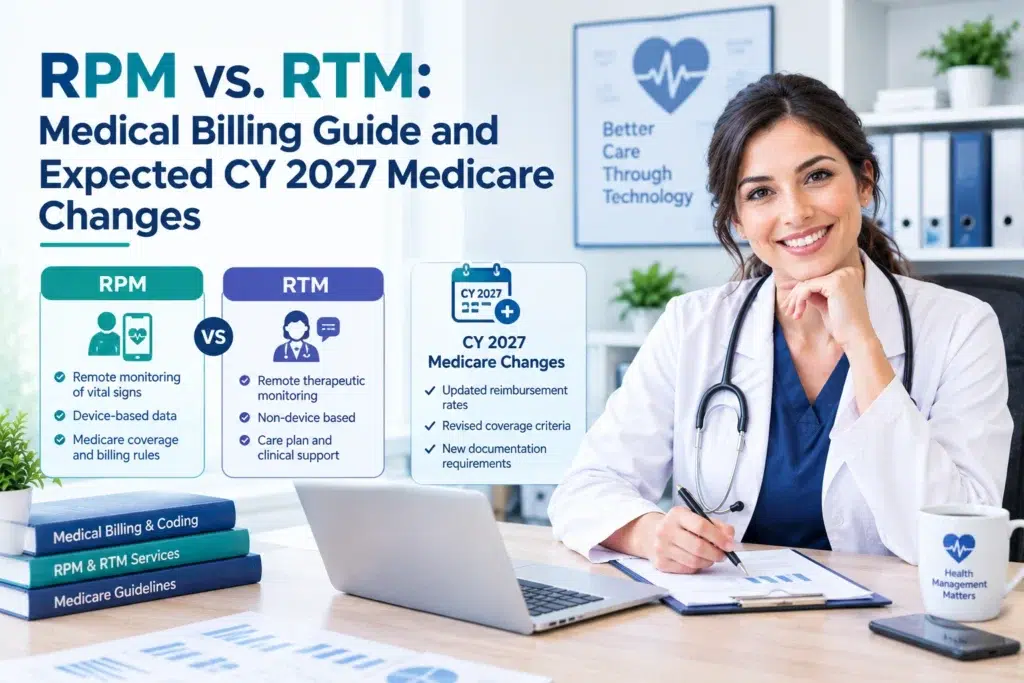
Remote patient monitoring (RPM) bills Medicare for health data collected through connected medical devices, such as blood pressure, weight, oxygen levels, and blood glucose. Remote therapeutic monitoring (RTM) covers non-physiological data, such as muscle and respiratory health, treatment adherence, and response to therapy. Both services cannot be billed for the same patient in the same month.
For 2027, CMS has proposed several changes that are not yet final. These include allowing only employed staff to bill for these services, requiring an initial visit, requiring patients to be established for RTM, lowering payment rates, and possibly combining four codes into one G-code bundle. If finalized, these changes would take effect on January 1, 2027.
What Is Remote Patient Monitoring (RPM)?
Remote Patient Monitoring (RPM) is a healthcare service that allows providers to monitor patients’ health readings, such as blood pressure, heart rate, weight, and blood sugar, remotely using connected medical devices without requiring patients to visit the clinic.
Medicare has covered RPM since 2019. The device must meet the FDA’s definition of a medical device and send data automatically so readings that patients enter manually do not qualify. Some of the common RPM programs help manage conditions such as high blood pressure using connected blood pressure cuffs, heart failure using weight scales, diabetes using glucose meters, and COPD using pulse oximeters.
Every RPM claim has three main parts:
(1) setting up the device and teaching the patient how to use it
(2) supplying the device and collecting transmitted data
(3) managing the patient’s treatment.
Treatment management includes clinical staff time and at least one live, interactive conversation with the patient or caregiver each month. The HHS Office of Inspector General (HHS-OIG) found that about 43% of Medicare enrollees did not receive all three required components. This finding is one reason behind the proposed changes for Calendar Year (CY) 2027.
What Is Remote Therapeutic Monitoring (RTM)?
Remote Therapeutic Monitoring (RTM) tracks how well patients follow and respond to their treatment plans. It can monitor exercise routines, pain levels, respiratory therapy, and participation in cognitive behavioral therapy (CBT). Medicare began covering RTM in 2022. According to CMS guidance (MLN901705), patients can report their own treatment data but it must be sent through a connected device that meets the FDA’s definition of a medical device. An app alone does not qualify for RTM billing without a qualifying connected device.
RTM also allows more types of healthcare providers to bill for these services. Physical therapists, occupational therapists, and speech-language pathologists can bill for RTM under the sometimes therapy designation which RPM does not offer.
RPM vs. RTM at a Glance
Feature | RPM | RTM |
Data type | Physical health readings, such as blood pressure, weight, oxygen levels, and blood sugar | Treatment-related data, such as pain, muscle and respiratory health, treatment adherence, and CBT participation |
Device requirements | FDA-defined medical device that automatically sends data | FDA-defined medical device; data may include information entered by the patient |
Established patient (2026) | Required | Not required |
Established patient (proposed for 2027) | Required | Required if the proposal is finalized |
Who can bill | Eligible physicians and non-physician practitioners (NPPs) who can bill E/M services | Eligible physicians and NPPs, plus physical therapists (PTs), occupational therapists (OTs), and speech-language pathologists (SLPs), subject to applicable billing rules |
Setup code | 99453 | 98975 |
Device supply codes | 99454 (16–30 days); 99445 (2–15 days) | 98976 / 98984 (respiratory); 98977 / 98985 (musculoskeletal); 98978 / 98986 (CBT) |
Treatment management codes | 99470, 99457, 99458 | 98979, 98980, 98981 |
Billing for the same patient in the same month | Cannot be billed alongside RTM for the same patient in the same month | Cannot be billed alongside RPM for the same patient in the same month |
2026 RPM CPT Codes and Medicare Rates
The following rates are 2026 national estimates for the standard Medicare Physician Fee Schedule. Actual payment can vary by locality and applicable payment adjustments.
- CPT 99453 — Setup and patient education: Approximately $21.71. Covers initial device setup and patient education, generally once per episode.
- CPT 99454 — Device supply and data transmission: Approximately $52.11. Requires 16–30 days of data in a 30-day period.
- CPT 99445 — Shorter device monitoring period: Approximately $52.11. Covers 2–15 days of data in a 30-day period.
- CPT 99470 — Initial treatment management: Approximately $26.05. Covers the first 10 minutes of management in a calendar month with at least one real-time interactive communication.
- CPT 99457 — Treatment management: Approximately $51.77. Covers the first 20 minutes of management in a calendar month, including at least one real-time interactive communication.
- CPT 99458 — Additional treatment management: Approximately $41.42 for each additional 20 minutes. This is an add-on code to 99457.
2026 RTM CPT Codes and Medicare Rates
The following rates show reported 2026 national amounts. CBT device-supply payment requires confirmation with the relevant Medicare Administrative Contractor (MAC).
- CPT 98975 — Setup and patient education: Approximately $21.71. Covers initial device setup and patient education, generally once per episode.
- CPT 98976 — Respiratory device supply: Approximately $52.11. Covers 16–30 days of monitoring in a 30-day period.
- CPT 98984 — Shorter respiratory monitoring period: Approximately $52.11. Covers 2–15 days of monitoring in a 30-day period.
- CPT 98977 — Musculoskeletal device supply: Approximately $51.44. Covers 16–30 days of monitoring in a 30-day period.
- CPT 98985 — Shorter musculoskeletal monitoring period: Approximately $51.44. Covers 2–15 days of monitoring in a 30-day period.
- CPT 98978 — CBT device supply: Contractor-priced. Check the applicable MAC fee schedule for the payment amount.
- CPT 98986 — Shorter CBT monitoring period: Verify the applicable MAC pricing before publishing a dollar amount.
- CPT 98979 — Initial treatment management: Approximately $26.39. Covers the first 10 minutes of management in a calendar month, with at least one real-time interactive communication.
- CPT 98980 — Treatment management: Approximately $54.11. Covers the first 20 minutes of management in a calendar month.
- CPT 98981 — Additional treatment management: Approximately $41.42 for each additional 20 minutes. This is an add-on code to 98980.
Billing Rules That Apply to Both Programs
One device-supply code per 30 days
Choose either the 2–15-day code or the 16–30-day code. You cannot bill both for the same monitoring period. For RTM, choose the code based on the type of condition being monitored.
Bill one main management code per month
For RPM, choose either 99470 or 99457 based on the documented time. For RTM, choose either 98979 or 98980. The add-on codes 99458 and 98981 can be billed only after meeting the requirements for 99457 and 98980, respectively.
A live conversation is required
Each management code requires at least one real-time, interactive conversation with the patient or caregiver. This conversation also counts toward the total management time.
Only one practitioner can bill remote monitoring
Only one practitioner can bill remote monitoring for the same patient during a 30-day period. Decide who will handle the billing before starting the program.
Do not bill RPM and RTM together
You cannot bill both services for the same patient in the same month.
Other care-management services can be billed together
RPM or RTM can be billed alongside services such as chronic care management (CCM), transitional care management (TCM), behavioral health integration (BHI), principal care management (PCM), and chronic pain management, as long as the same time is not counted toward multiple services.
Monitoring can continue during a surgical global period
You can bill for remote monitoring during this period if it addresses a health condition unrelated to the surgery.
Keep proper documentation
Record patient consent, use of an FDA-defined medical device, automatic data transmission, and appropriate supervision of clinical staff under the incident-to billing rules (42 CFR 410.26).
Patients have out-of-pocket costs
Medicare Part B deductibles and 20% coinsurance generally apply. Explain these possible costs to patients before enrolling them in the program.
Who Can Bill RPM and RTM, and Which Modifiers Apply
Remote Patient Monitoring (RPM): Physicians and non-physician practitioners (NPPs) who are eligible to bill evaluation and management (E/M) services can bill RPM.
Remote Therapeutic Monitoring (RTM): Physicians and eligible NPPs can bill RTM. Physical therapists (PTs), occupational therapists (OTs), and speech-language pathologists (SLPs) can also bill RTM when they meet the applicable Medicare requirements.
Therapists must use the correct modifier to identify the type of therapy provided:
- GP: Used for physical therapy services.
- GO: Used for occupational therapy services.
- CQ: Used when a physical therapist assistant provides services that meet Medicare’s assistant-services billing criteria.
- CO: Used when an occupational therapy assistant provides services that meet Medicare’s assistant-services billing criteria.
CMS has clarified that the CQ and CO modifiers apply to the new RTM treatment management code 98979 but not to the device-supply codes 98984 and 98985.
Important clarification: CMS guidance document MLN901705 states that remote monitoring can be billed by physicians and NPPs eligible to bill E/M services. However, this statement is too broad when applied to RTM because eligible therapists can also bill RTM under applicable Medicare rules.
Expected CY 2027 Medicare Changes for RPM and RTM (Proposed)
Employed clinical staff only
CMS proposes that RPM and RTM services can be billed only when the clinical staff are direct employees of the billing practitioner or medical group. Staff do not have to work in the same building but they must work under the practitioner’s general supervision and follow Medicare’s incident-to billing rules.
Practices can still purchase software, medical devices, and data services from outside vendors. However, they would not be able to bill for the time of nurses employed by those vendors. CMS believes outsourcing clinical work can make patient care less coordinated and reduce the practitioner’s control over treatment.
A separately billable initiating visit
CMS proposes that the billing practitioner must see the patient before starting RPM or RTM. This visit can take place in person or through Medicare-covered telehealth and must qualify for separate payment.
During the visit, the practitioner must discuss remote monitoring with the patient, determine that it is medically appropriate, and document the patient’s consent. A visit that does not include a discussion about remote monitoring would not meet this requirement.
Industry reviewers have also noted that the proposal does not clearly explain how this rule would apply to patients who started remote monitoring before January 1, 2027.
RTM limited to established patients
RPM already requires patients to be established with the billing practitioner after the end of the public health emergency flexibilities. CMS proposes to apply the same requirement to RTM.
This change could affect physical therapy and orthopedic practices that currently enroll new patients in RTM at their first visit. If the proposal becomes final, these practices may need to change their intake process to establish the patient relationship before starting RTM.
Lower Payments for Setup, Devices, and Management
CMS proposes lowering payments for RPM and RTM codes because it believes remote monitoring devices cost less than originally estimated. The proposal would change how practice expenses are calculated for setup, device supply, and treatment management codes.
- Setup codes (99453, 98975): Would use the expense values for blood pressure education code 99473.
- RPM device codes (99445, 99454): Would use the expense values for blood pressure data code 99474.
- RTM device codes: Would use the expense values for external ECG monitoring code 93270.
- Management codes: Practice expense amounts would be removed, but work RVUs would remain.
CMS has not provided exact payment amounts for each code. The final reductions will depend on the finalized rule. The proposed 2027 conversion factor is $32.84 for non-qualifying APM participants, down 1.68%, and $33.17 for qualifying APM participants, down 1.19%. These decreases are partly due to the expiration of the temporary 2.5% payment increase for 2026.
CMS Is Considering Four Combined G-Codes
CMS has not formally proposed new codes but is asking for feedback on combining 17 existing RPM and RTM codes into four G-codes.
- GRPM1: RPM setup and patient education.
- GRPM2: RPM device supply and treatment management, requiring at least two days of data, 20 minutes of management, and one real-time interaction per month.
- GRTM1: RTM setup and patient education.
- GRTM2: RTM device supply and treatment management, with the same monthly requirements as GRPM2.
If CMS adopts this approach in the future, practices no longer be able to bill separately for device supply when little or no treatment management takes place. Each required service would need to be provided to bill the combined code.
Current Rules vs. Proposed CY 2027 Changes
- Who can provide services: In 2026, contracted clinical staff can qualify under applicable billing rules. The proposal would limit billing to clinical staff directly employed by the practice.
- Starting monitoring: The proposal would require a separately billable initiating visit before monitoring begins.
- RTM patients: RTM can currently be provided to new or established patients, subject to applicable requirements. The proposal would limit it to established patients.
- Payment rates: Current 2026 rates would be replaced by revalued rates if the proposed changes are finalized.
- Billing codes: Current billing uses 17 CPT codes. CMS is seeking feedback on a possible four-G-code structure.
- Conversion factor: The 2026 non-qualifying APM conversion factor is $33.40. CMS proposes $32.84 for 2027.
Medicare Advantage and Commercial Payers
The proposed changes for 2027 apply to Medicare Part B fee-for-service. Medicare Advantage plans and commercial insurance companies can have different coverage, documentation, and billing rules. They also use different codes or follow different timelines.
If Medicare makes up less than half of your patients, use its rules as a starting point but check the remote monitoring policies of each major insurance payer separately.