Almost all people know that medical billing is complicated. But very few people know that medical billing is not one single process. It consists of two processes that occur between what happens before a patient receives care and what happens after.
Front-end and back-end billing are the two halves of your revenue cycle. To run a successful practice, it is important to make both processes work well together. So let’s discuss the differences between front-end and back-end medical billing and how improving both sides of your revenue cycle can help your practice get paid faster.
Front-end Medical Billing vs Back-end Medical Billing
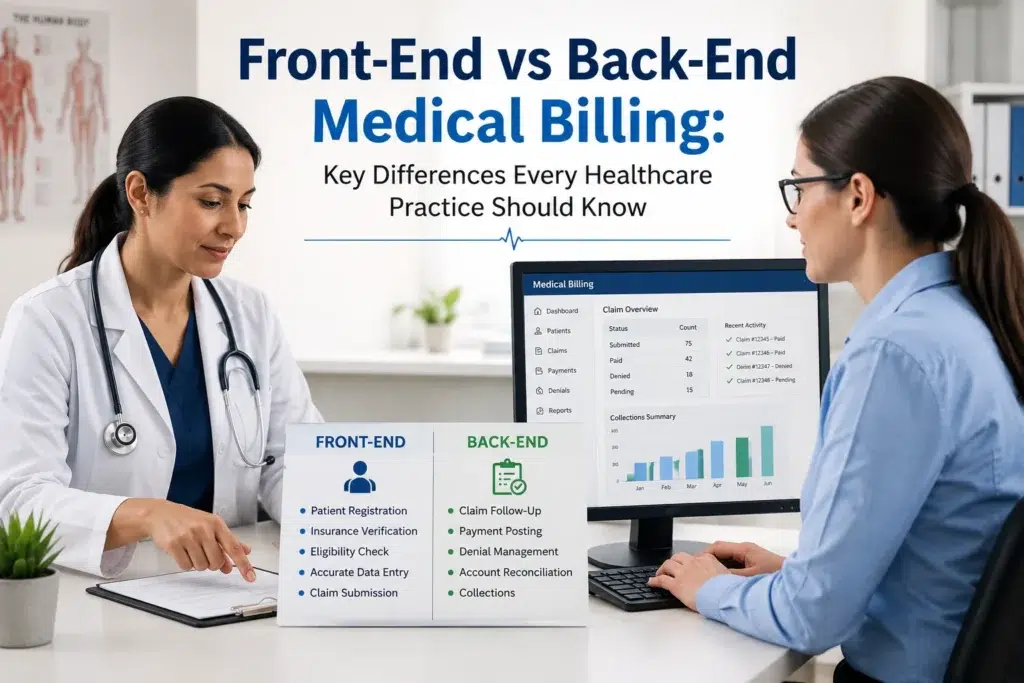
Front-end medical billing includes all activities performed before the patient receives care, such as scheduling appointments, verifying insurance, collecting patient information, obtaining prior authorizations, and collecting copays.
Back-end medical billing begins after the patient visit and includes medical coding, claim submission, payment posting, denial management, appeals, patient billing, and collections.
Both processes are essential. Strong front-end workflows prevent billing problems, while efficient back-end operations ensure providers receive accurate and timely reimbursement.
Understanding the Medical Billing Process
The front-end team hands off accurate patient and insurance information to the clinical and billing staff. The back-end team then takes that information, converts medical services into billable claims, submits them to insurance companies, follows up on unpaid claims, and posts payments.
If either team makes the process wrong, the overall revenue gets impacted.
This is why healthcare organizations increasingly focus on optimizing the entire Revenue Cycle Management (RCM) process rather than treating billing as a single department.
What Is Front-End Medical Billing?
Front-end medical billing includes every administrative task completed before or during the patient’s visit.
It is always considered a critical process because errors made at the front end don’t just cause problems at the front end. They travel downstream and come weeks or months later in the form of denied claims, payment delays, and frustrated patients who think your billing department has made a mistake, even when the real issue started at registration.
The main purpose of front-end revenue cycle management is to prevent billing errors before they happen and ensure the claim is clean from the very beginning.
Key Responsibilities of Front-End Medical Billing
- Appointment Scheduling: Patient information is collected, appointment types are confirmed, and providers are matched with insurance requirements.
- Patient Registration: Staff members collect full legal name, date of birth, address, phone number, insurance details, and emergency contact.
- Insurance Eligibility Verification: verify coverage status, effective dates, deductibles, copays, coinsurance, out-of-pocket limits, and covered services
- Prior Authorization: Many procedures require insurance approval before treatment, including prior authorizations, referral documentation, and medical necessity requirements.
- Copay Collection: Collecting patient responsibility during check-in improves cash flow significantly as compared to those who wait until after the visit.
- Financial Counseling: Patients appreciate understanding their financial responsibility before treatment. Front-end staff explain expected costs, payment plans, insurance benefits, and deductibles.
Benefits of Strong Front-End Billing
The best front-end revenue cycle management process can:
- Reduce claim denials
- Improve clean claim rates
- Speed up reimbursements
- Increase patient satisfaction
- Improve cash flow
- Reduce administrative rework
- Lower billing costs
Many revenue problems actually originate before a claim is ever submitted.
What Is Back-End Medical Billing?
If the front end is about preparation, the back end is where all that preparation either pays off or falls. Back-end billing picks up after the patient’s visit ends and carries the process through to final payment, which, depending on how efficiently things are running, could happen in 20 days or 200 days. This back-end revenue cycle management stage focuses on converting clinical documentation into claims, securing reimbursement, and following payments through completion.
Key Responsibilities of Back-End Medical Billing
- Medical Coding: Certified coders review provider documentation and assign the accurate ICD-10 diagnosis codes, CPT procedure codes, and HCPCS codes to accurately bill services.
- Charge Entry: Charges are entered into the billing system based on documentation and coding. Errors during charge entry can lead to underbilling or overbilling.
- Claim Creation: Claims are generated using patient information, coding, provider details, and payer requirements. Billing teams prefer claim scrubbing to detect errors automatically before submission.
- Claim Submission: Clean claims are electronically submitted to insurance companies. Electronic submission speeds processing and reduces manual errors.
- Payment Posting: Once insurance payments are received, they are posted to patient accounts. It also identifies adjustments, remaining balances, patient responsibility, and underpayments.
- Denial Management: If claims are denied, billing specialists check denied claims by reviewing denial reason codes, missing documentation, coding errors, eligibility issues, and authorization problems.
- Appeals: When claims are wrongly denied, appeals are prepared with supporting documentation. Successful appeals recover revenue that might otherwise be lost.
- Patient Billing: After insurance processing is complete, patients receive statements for remaining balances. Modern practices often provide online payment portals, payment plans, and automated reminders.
- Accounts Receivable (A/R) Follow-Up: Outstanding claims require continuous monitoring. Billing teams contact insurance companies, investigate delays, and work on unpaid claims until payment is received.
Benefits of Effective Back-End Billing
Efficient back-end revenue cycle management help practices:
- Increase reimbursement rates
- Reduce claim denials
- Recover underpayments
- Improve collections
- Reduce A/R days
- Maintain compliance
- Improve profitability
How Front-End Errors Affect Back-End Billing
You can have the best coders in the world on your back-end team, but if registration is collecting inaccurate insurance information on the front end, those coders are working with a flawed foundation.
The reverse is also true, even a perfect front-end intake doesn’t help if your denial management process is nonexistent.
Practices that treat front-end and back-end billing as separate departments with separate goals, separate metrics, and limited communication consistently underperform compared to those that view the revenue cycle as a single and interconnected system.
The most effective practices hold regular cross-functional meetings between front-desk staff and billing teams. When the back-end team notices an increase in eligibility-related denials, the front-end team needs to hear about it immediately.
Partner With M&M Claims Care for End-to-End Medical Billing Support
At M&M Claims Care, we provide comprehensive revenue cycle management solutions that help healthcare practices reduce claim denials, improve reimbursement rates, and keep cash flow moving. From insurance verification and eligibility checks to coding, claim submission, denial management, and accounts receivable follow-up, our experienced billing professionals handle every stage of the revenue cycle with precision. If you’re ready to maximize your practice’s revenue, contact M&M Claims Care today at +1 (267) 768-7915 and see how our customized billing solutions can support your long-term success.