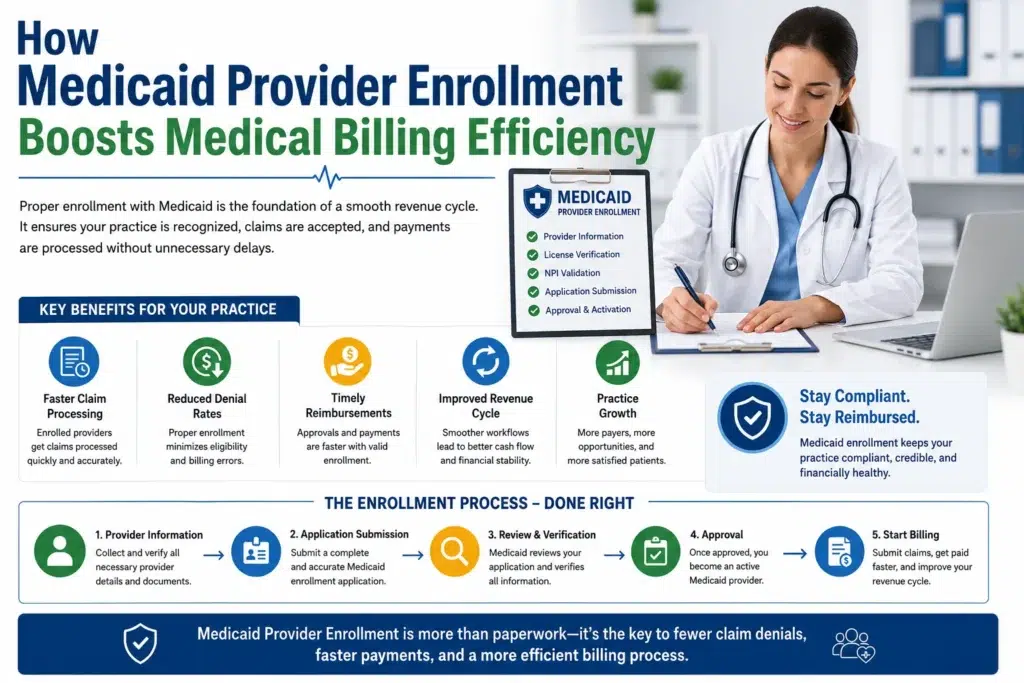
Medicaid is an essential part of healthcare coverage for the people of America who can’t afford medical care. Proper enrollment can improve the efficiency of your medical billing operations. When providers are correctly enrolled with Medicaid, claims move faster, reimbursement delays decrease, denial rates drop, and revenue cycles become much smoother. Medicaid provider enrollment helps healthcare organizations maintain compliance, improve operational efficiency, and support financial stability. On the other hand, incomplete or inaccurate enrollment can lead to claim rejections, payment interruptions, and unnecessary administrative headaches.
Let’s discuss how Medicaid provider enrollment status directly impacts medical billing efficiency and why healthcare organizations should prioritize it as an important part of their revenue cycle strategy.
Quick Answer
How does Medicaid provider enrollment improve billing?
- Enables providers to bill Medicaid legally
- Reduces enrollment-related claim denials
- Speeds reimbursement
- Supports compliance with CMS requirements
- Prevents payment interruptions
- Improves Revenue Cycle Management (RCM)
What Is Medicaid Provider Enrollment?
Medicaid provider enrollment is the process through which healthcare providers register and receive authorization to offer services to Medicaid beneficiaries and receive reimbursement from state Medicaid programs. This step is necessary for payer relationships. Each state has its own rules.
This process generally includes:
- Submitting provider credentials
- Verifying licenses and certifications
- Completing background checks
- Providing tax and business information
- Meeting state-specific compliance requirements
- Regular revalidation and updates
Unlike credentialing, which verifies a provider’s qualifications, licenses, and background, enrollment is specifically about establishing the provider as a recognized billing entity within the Medicaid system. Credentialing usually happens first but enrollment enables a provider to submit claims and receive reimbursement.
Without successful enrollment, providers cannot legally bill Medicaid for services rendered to eligible patients and the practice becomes invisible to the program.
Why Medicaid Enrollment Matters in Medical Billing
Medicaid enrollment is necessary for successful Medicaid billing. Even if your claim or coding processes are accurate, your claim still won’t get paid if the provider isn’t properly enrolled.
Enrollment directly impacts:
- Claim acceptance rates
- Payment timelines
- Revenue cycle efficiency
- Compliance management
- Patient access to care
- Administrative workload
Simply put, enrollment and billing both work together.
The Connection Between Medicaid Enrollment and Revenue Cycle Management
Revenue Cycle Management is a financial process starting from patient registration to final reimbursement. Medicaid provider enrollment plays an important role during the front-end stage of the revenue cycle.
Proper Enrollment Helps Ensure:
- Accurate provider information
- Eligibility to submit Medicaid claims
- Correct payer credentialing
- Faster claims adjudication
- Reduced administrative errors
Errors at the enrollment stage often create problems throughout the entire billing cycle.
How Medicaid Provider Enrollment Boosts Medical Billing Efficiency
Enrollment Is the First Claim Check
Before a payer looks at your codes, your modifiers, or your documentation, it checks whether this provider actually enrolled and is in good standing. Medicaid is run state by state under a federal framework, which means a provider who’s cleared to bill in Texas through TMHP isn’t automatically cleared in Louisiana or Oklahoma. Each state has its own portal, its own application, and its own provider agreement.
A billing team may code a claim perfectly and submit it on time, yet still receive a denial because of an enrollment issue like a location wasn’t added to their file or because they missed their Medicaid revalidation date.
And you can’t resubmit denied claims like coding denials but you have to pause billing entirely until the provider’s status is corrected, which means every claim submission depends on the enrollment process.
Managing Revalidation Effectively
Many practices think that enrollment is a one-time process but they should know that enrollment isn’t permanent. Federal rules require Medicaid providers to revalidate their enrollment at least every five years. And if you miss this window, you are not just facing a late fee but can be disenrolled outright, which means every claim submitted after your due date gets denied until you’re reinstated.
In 2026, CMS asked state Medicaid programs to check high-risk providers more often and complete revalidation faster.
So it is clear that Medicaid revalidation should not be handled at the last minute. Practices that keep track of renewal dates, update their contact information in state portals, and respond early to document requests can avoid billing interruptions.
Accurate Enrollment Prevents Denials
Many Medicaid claim denials happen because provider information is outdated or does not match across records. This can be an old address, different ownership information on separate forms, or a practice location that was never officially added even though the provider has been working there.
These problems do not appear as coding errors. Instead, they show up as denials that seem random until someone checks the provider enrollment file and discovers the information is no longer accurate.
The best way to avoid these denials is to update provider records as soon as any change happens, rather than waiting for the next renewal cycle. Keeping enrollment information current prevents many denials before they occur, saving time and reducing extra work later.
Enhances Compliance and Reduces Regulatory Risks
Healthcare regulations are becoming stricter every year.
Medicaid programs require providers to maintain active licenses, update ownership information, complete periodic revalidation, and report changes quickly.
Failure to comply can result in payment suspensions, claim denials, audits, and provider termination from Medicaid networks.
A strong enrollment process helps providers stay compliant and avoid financial penalties.
It Reduces Manual Rework and Staff Burden
When a claim is denied because of an enrollment issue, the billing team has to identify the problem and research it. This takes time away from more valuable work, such as analyzing denial trends, managing payer contracts, and helping patients with billing questions.
A well-managed enrollment process helps prevent these problems. When every provider’s enrollment status is verified before Medicaid claims are submitted, fewer claims need to be corrected and resubmitted. This reduces the workload on billing staff and allows them to focus more on collections and improving revenue instead of fixing avoidable administrative issues.
Best Practices for Medicaid Provider Enrollment
- Start Enrollment Early
- Maintain Accurate Provider Records
- Monitor Revalidation Deadlines
- Perform Regular Internal Audits
- Partner with Enrollment and Medical Billing Experts
How M&M Claims Care Helps Providers Simplify Medicaid Enrollment
Managing Medicaid enrollment requirements can be time-consuming and frustrating for many practices. It includes a number of steps, including credential verification and documentation management, revalidation tracking and compliance monitoring that require attention and expertise.
At M&M Claims Care, we help healthcare providers simplify the complexities of Medicaid provider enrollment and optimize their medical billing operations. Our experienced team works closely with practices to minimize delays, reduce claim denials, and improve overall revenue cycle performance. Our credentialing services also help providers get reimbursed while staying compliant and financially healthy.