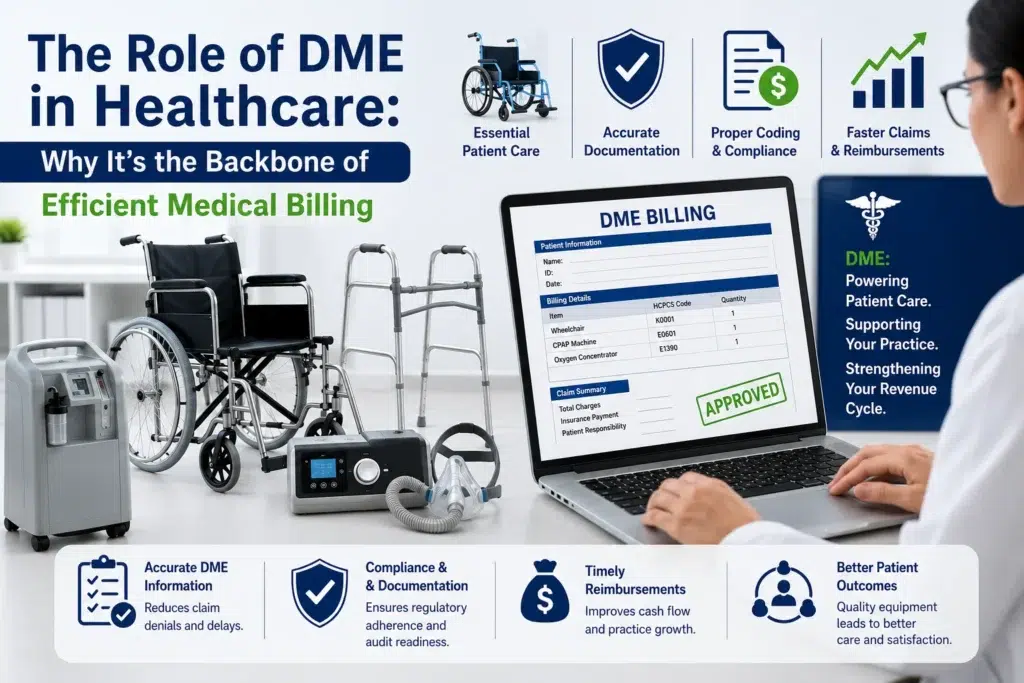
Durable Medical Equipment (DME) is an important part of healthcare. It includes medical equipment that helps patients manage their health at home like wheelchairs, CPAP machines, oxygen concentrators, and walkers. These devices are used to give patients comfort, independence, and quality of life. But providers can only supply this equipment if they receive proper payment and here DME billing becomes challenging because these items must meet payer strict guidelines.
That’s why for healthcare providers, DME suppliers, and revenue cycle teams, it is important to understand DME billing as it follows different rules, documentation requirements, and payment processes. So let’s discuss what DME is, why it is important for patient care, and how proper DME billing helps providers get paid accurately and on time.
What Is DME in Healthcare?
Durable Medical Equipment (DME) is reusable medical equipment that a doctor prescribes for patients to use at home. It helps people manage long-term illnesses, injuries, or disabilities and supports their daily care.
To qualify as DME under Medicare and most insurance plans, the equipment must meet criteria including:
- Be strong enough for repeated use
- Have a specific medical purpose
- Be needed because of an illness or injury
- Be suitable for use at home
For equipment classified as DME after January 1, 2012, it generally must also have an expected life of at least three years.
Some common examples of DME include:
- Respiratory equipment including CPAP and BiPAP machines, oxygen concentrators, nebulizers, and ventilators
- Mobility equipment like Wheelchairs, walkers, canes, power wheelchairs, and hospital beds
- Diabetes supplies including Insulin pumps, continuous glucose monitors (CGMs), and blood glucose test strips
- Orthotics and prosthetics such as Braces, splints, and artificial limbs
- Other supportive devices like TENS units, patient lifts, and commode chairs
DME helps patients receive the care they need without staying in a hospital or care facility. It supports independent living, reduces hospital readmissions, and can lower healthcare costs by allowing patients to manage their conditions safely at home.
Why DME Billing Is Different From Standard Medical Billing
Most healthcare providers bill using CPT codes which are used for medical services and procedures. But DME billing is different. Instead of using CPT codes, it mainly uses HCPCS Level II codes. These codes were created by CMS to identify medical equipment, supplies, and other items that CPT codes do not cover.
DME billing requires providers to get two things right:
- Clinical documentation: The claim must include a doctor’s order, the correct diagnosis code, and records showing why the equipment is medically necessary.
- Accurate billing details: Providers must use the correct HCPCS code, modifiers, quantity, and indicate whether the equipment is being rented or purchased.
If any of this information is missing or incorrect, the claim can be denied, delayed, or selected for an audit.
What Are DME Billing Codes?
As we explain, DME billing uses HCPCS Level II codes to identify the medical equipment, supplies, or accessories being billed. These HCPCS Level II codes describe the actual item provided to the patient.
Some examples of DME billing codes include:
- E-codes: Used for durable medical equipment such as wheelchairs, hospital beds, CPAP machines, and oxygen equipment. Like E0143 used for folding walkers.
- K-codes: Often used for power wheelchairs, scooters, and related accessories. Code K0823 is used for power wheelchairs.
- A-codes: Commonly used for medical supplies, such as CPAP masks and tubing, diabetic testing supplies, and wound care items. Like A4351 for Intermittent urinary catheter.
Along with the HCPCS code, suppliers must also use the correct modifier. Modifiers provide extra details such as whether the equipment is new or used, rented or purchased, and being billed under a specific medical situation.
Even if the HCPCS code is correct, using the wrong modifier can cause the claim to be denied.
The Core Elements of the DME Billing Process
Standard Written Orders (SWOs)
A Standard Written Order (SWO) is a doctor’s written prescription for medical equipment. In most cases, the supplier must have this order before delivering the equipment. If the SWO is missing or incomplete, then Medicare and other insurance providers can deny the claim, even if the patient needs the equipment.
Medical Necessity Documentation
A doctor’s order alone is not enough. Insurance companies also want proof that the equipment is medically necessary. They require medical records, diagnosis codes, and clinical notes that clearly explain why the patient needs the equipment.
HCPCS Codes and Modifiers
DME claims use HCPCS Level II codes to identify the equipment being billed. The right code along with the right modifier such as whether the item is rented or purchased, is important for accurate billing. Using any wrong code or modifier always leads to claim delays or denials.
Prior Authorization
Some expensive DME items like power wheelchairs, advanced braces, ventilators, and home oxygen equipment require prior authorization before they can be billed. If you never get approval for these required items then the claim is likely to be denied.
Billing Frequency and Replacement Limits
Insurance companies also set limits on how often certain DME items can be replaced or billed. For example, CPAP supplies and diabetic shoes can only be billed within specific timeframes. Claims that exceed these limits without proper medical documentation are usually denied.
Supplier Enrollment and Accreditation
DME suppliers must meet Medicare’s DMEPOS standards to bill for equipment. This includes maintaining proper accreditation, having a valid surety bond, and operating from an approved business location. Suppliers must also continue meeting these requirements to remain compliant and receive payment.
Who Pays for DME?
DME can be covered by different types of insurance. It depends on the patient’s plan.
- Medicare Part B: It covers approved DME when prescribed by a doctor and supplied by an approved DME provider. Patients usually pay 20% after meeting their deductible.
- Medicaid: This coverage varies by state. Some items require prior authorization.
- Private Insurance: Coverage and approval rules of private insurance depend on the insurance plan, so benefits should always be checked first.
- Medicare Advantage: These plans cover DME but may have different provider networks and prior authorization requirements than Original Medicare.
- Self-Pay: Patients pay out a lot of expenses if they don’t have coverage or choose equipment their insurance doesn’t cover.
But it is important to check insurance benefits and prior authorization before delivering the equipment as it helps you to avoid claim denials and payment delays.
How DME Billing Improves Revenue Cycle Management
DME billing is an important part of the healthcare revenue cycle. When it is handled correctly, it helps providers get paid faster, reduce claim denials, and stay compliant with insurance rules.
Faster Payments and Better Cash Flow
Accurate documentation, correct HCPCS codes, and completed prior authorizations help claims get approved the first time. This reduces delays, shortens accounts receivable (AR) days, and improves cash flow.
Fewer Claim Denials
Many DME claim denials happen because of missing documents, coding mistakes, lack of prior authorization, or billing items too often. Checking these details before submitting a claim helps prevent denials and protects revenue.
Better Audit Preparation
Insurance companies and Medicare can audit DME claims to make sure the equipment was medically necessary. Keeping organized records, such as Standard Written Orders (SWOs), clinical notes, and proof of delivery, makes audits easier and lowers the risk of payment recovery.
Ongoing Compliance
DME suppliers must continue meeting Medicare and insurance requirements, including maintaining accreditation, documentation, and other supplier standards. Staying compliant helps providers avoid penalties and continue billing insurance companies.
Better Coordination Between Teams
DME billing often requires close communication between clinical staff and billing teams. Billing software can help by tracking required documents, checking coding accuracy, and monitoring prior authorizations. This reduces errors and helps claims move through the billing process more smoothly.
Renting vs. Buying DME: What's Better for Billing?
DME is billed as a rental or a purchase and affects how and when the supplier gets paid. The correct billing method depends on the equipment and the insurance provider’s rules.
Rental Billing
With rental billing, the supplier receives monthly payments instead of one full payment. Medicare requires some items like oxygen equipment and certain power wheelchairs to be rented for a specific period before the patient can own them. Suppliers must keep track of each rental month and know when the rental period ends.
Purchase Billing
With purchase billing, the supplier is usually paid one larger amount. This applies to equipment that can be bought outright or after a required rental period ends. Because there are no monthly claims, all documentation must be complete and accurate before the claim is submitted.
Common DME Billing Challenges in 2026
DME billing rules change frequently and are becoming stricter day by day. That’s why accurate billing is now becoming more important than ever. Some of the biggest challenges include:
- Stricter claim reviews: Claims with missing or incomplete documents can be rejected before they are processed.
- More prior authorisations: Many expensive DME items now require approval before billing.
- Replacement limits: Insurance plans have strict rules on how often certain equipment and supplies can be replaced.
- More audits: Medicare and other payers are checking more closely to make sure medical records support every claim.
- Changing billing rules: Billing teams must keep up with new HCPCS codes and payer requirements, which can be difficult without automated tools.
To handle these challenges, expert billing services are required to know how to follow latest billing rules and keep documentation complete to reduce denials and improve reimbursement.
Simplify DME Billing With M&M Claims Care
DME billing doesn’t have to be stressful. That’s why M&M Claims Care helps healthcare providers simplify medical billing and keep their revenue cycle running smoothly. Our team handles insurance verification, claim submission, denial management, A/R follow-up, payment posting, and more. With our support, you can reduce billing errors, get paid faster, and improve overall revenue cycle management. Contact to M&M Claims Care and take the stress out of your medical billing.