Healthcare providers depend on timely insurance reimbursements to maintain their financial stability. But delayed payments, denied claims, and collection challenges become barriers to healthy revenue cycle management. The Assignment of Benefits (AOB) helps solve these issues by allowing insurers to send payments directly to providers. It’s a critical part of the medical billing process that decides who receives insurance payments and how claims are processed.
Most of the time, patients misunderstand this document, which leads to confusion about insurance payments, increased costs, and financial responsibility.
So let’s understand the concept of Assignment of Benefits in medical billing, its main purpose, and the insurance claim workflow.
What is an Assignment of Benefits (AOB) in Medical Billing?
Assignment of Benefits (AOB) is a legal agreement through which a patient authorizes their insurance company to send payment directly to a healthcare provider for covered medical services.
This contract enables insurance companies to pay providers for the specific healthcare services.
In simple terms, when a patient signs an Assignment of Benefits form, they are telling their insurance company to pay my doctor, clinic, hospital, or other healthcare provider directly rather than me for treatments that are covered.
In addition to making the reimbursement process easier, this permission reduces the need for providers to collect full payment from patients while they wait for insurance reimbursements.
Who Uses Assignment of Benefits?
Assignment of Benefits is commonly used in:
- Physician practices
- Hospitals
- Urgent care centers
- Specialty clinics
- Mental health practices
- Physical therapy clinics
- Home healthcare agencies
- Diagnostic laboratories
- Imaging centers
Without an Assignment of Benefits agreement, insurers can issue payments directly to patients and then providers collect their reimbursement. This traditional process increases collection difficulties.
Why Is Assignment of Benefits Important?
Assignment of Benefits plays a major role in maintaining a healthy medical revenue cycle.
The Centers for Medicare & Medicaid Services (CMS) requires that providers keep accurate records to support their reimbursement claims. That’s why healthcare providers depend on quick insurance reimbursements to maintain efficient operations. By receiving payments directly from insurers, providers can:
- Boost cash flow
- Reduce payment delays
- Reduce the amount of time spent collecting
- Reduced administrative expenses
- Improve the tracking of claims
- Boost the effectiveness of reimbursement
Patients also benefit because they don’t have to handle insurance payments themselves before paying their provider.
In many healthcare organizations, the Assignment of Benefits is considered a foundational document that supports efficient billing and collections.
How Assignment of Benefits Works
Let’s discuss the process of Assignment of Benefits.
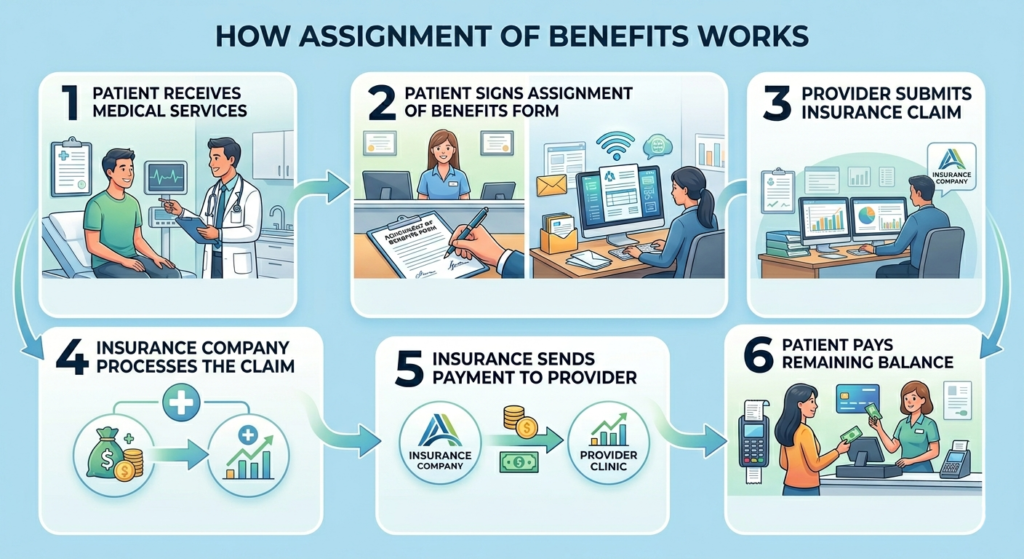
Step 1: Patient Receives Medical Services
A patient visits a healthcare provider to get medical services like treatment, consultation, testing, or another covered service. They visit different practices like:
- Primary care visits
- Specialist appointments
- Emergency care
- Physical therapy
- Diagnostic imaging
- Laboratory services
Step 2: Patient the Signs Assignment of Benefits Form
During registration or intake, the patient signs an Assignment of Benefits authorization.
This document grants permission for:
- Insurance pays the provider directly.
- Release of essential medical information
- Submission of claims on behalf of the patient
The signed form becomes part of the patient’s record.
Step 3: Provider Submits Insurance Claim
After services are rendered, the provider’s billing department submits a claim to the insurance company.
The claim includes:
- Details about the patient
- Details of insurance
- CPT codes
- ICD-10 codes for diagnostic
- Dates of service
- Details about the provider
Step 4: Insurance Company Processes the Claim
The insurance payer reviews the claim to check:
- Coverage eligibility
- Medical necessity
- Limitations of policy
- Deductible status
- Requirements for copayment
- Coinsurance responsibilities
Step 5: Insurance Sends Payment to Provider
As the Assignment of Benefits has been authorized, the insurer sends payment directly to the healthcare provider.
The provider receives:
- Reimbursement payment
- Explanation of Benefits (EOB)
- Remittance advice
Step 6: Patient Pays Remaining Balance
If any patient responsibility remains, such as:
- Deductibles
- Copayments
- Coinsurance
- Non-covered services
The provider bills the patient for the remaining balance.
This creates a simplified reimbursement process for everyone involved.
What Is an Assignment of Benefits Form?
An Assignment of Benefits form is a written authorization signed by the patient.
It permits healthcare providers to receive insurance payments directly from the patient’s insurer.
It’s just like a financial authorization document that transfers insurance payment rights from the patient to the provider.
Information Included in an Assignment of Benefits Form
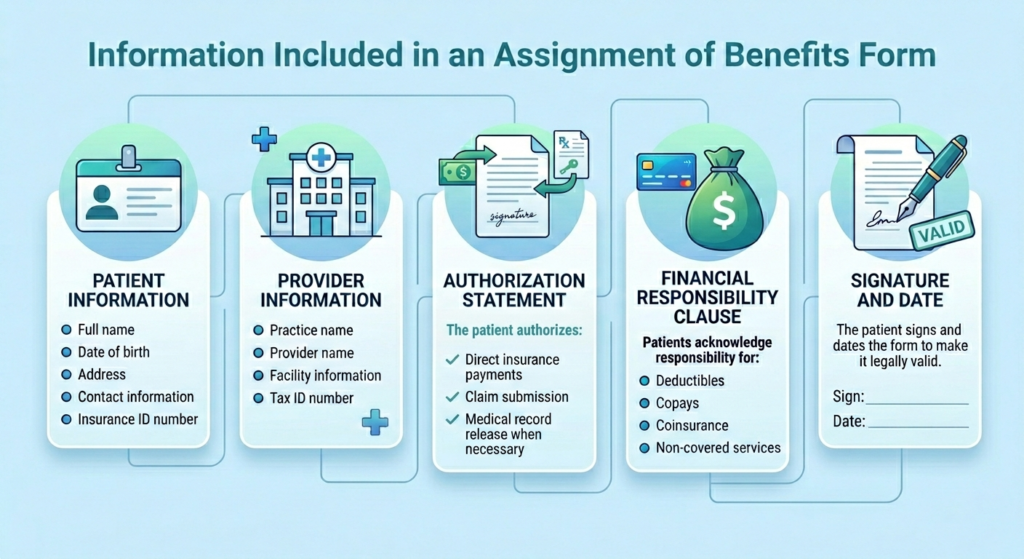
Although forms vary by organization, most include:
Patient Information
- Full name
- Date of birth
- Address
- Contact information
- Insurance ID number
Provider Information
- Practice name
- Provider name
- Facility information
- Tax ID number
Authorization Statement
The patient authorizes:
- Direct insurance payments
- Claim submission
- Medical record release when necessary
Financial Responsibility Clause
Patients acknowledge responsibility for:
- Deductibles
- Copays
- Coinsurance
- Non-covered services
Signature and Date
The patient signs and dates the form to make it legally valid.
Assignment of Benefits vs Authorization to Release Information
These documents are mostly confusing but both have different purposes.
Assignment of Benefits
It mainly focuses on payment rights.
It gives the provider direct authority for insurance reimbursement.
Authorization to Release Information
It focuses on privacy and medical records.
It allows providers to share necessary medical information with insurance companies for claim processing.
Many healthcare organizations combine these authorizations into one registration document.
Is Assignment of Benefits Legally Binding?
Yes.
An Assignment of Benefits form is generally considered a legally binding agreement when properly completed and signed.
But some specific regulations vary based on:
- State laws
- Contracts for insurance
- Federal laws
- Requirements for payers
Healthcare providers should maintain signed forms in patient records to support claim processing and reimbursement disputes if necessary.
Assignment of Benefits and Insurance Claims
The Assignment of Benefits process is linked to insurance claims management.
Without a valid AOB:
- Without an accurate AOB:
- It is still possible to handle claims.
- The patient can receive direct payment from insurance.
- Providers may experience collection difficulties
Using a valid AOB:
- Claims are handled more quickly.
- Payments are sent directly to suppliers.
- Revenue cycle operations improve
This is why the majority of medical practices receive AOB documentation during patient registration.
Benefits of Assignment of Benefits for Healthcare Providers
Faster Payments
When providers directly get payment, it eliminates unnecessary payment routing through patients. In this way, providers receive their payments sooner.
Improved Cash Flow
Consistent insurance payments improve practice financial stability. We all understand that better cash flow helps organizations to invest in staffing, technology, and patient care.
Reduced Collection Efforts
Collecting insurance reimbursements from patients after payment can be challenging.
Assignment of Benefits reduces this burden greatly.
Lower Administrative Costs
Billing teams spend less time tracking patient-issued insurance payments.
This improves overall operational efficiency.
Better Revenue Cycle Performance
Direct payments help improve key revenue cycle management, including:
- Days in Accounts Receivable (A/R)
- Collection rates
- Payment turnaround times
Benefits of Assignment of Benefits for Patients
AOB is not only helpful for providers but patients benefit too.
Simplified Insurance Process
Patients don’t have to receive and forward insurance checks.
The insurer pays the provider directly.
Reduced Administrative Hassles
Patients avoid paperwork associated with transferring insurance payments.
Better Billing Transparency
Patients can easily see what insurance paid and what balance remains.
Improved Access to Care
Providers are often more willing to accept insurance-covered patients when reimbursement processes are simplified.
Assignment of Benefits and Commercial Insurance
Most commercial insurance plans also allow Assignment of Benefits.
But payer requirements vary.
Some insurers:
- Require specific forms
- Require updated authorizations periodically
- Have network-specific rules
- Apply state-specific regulations
Medical billing teams should verify payer policies regularly.
Assignment of Benefits and Out-of-Network Providers
Out-of-network billing can create additional complexity.
In some cases:
- Insurance providers can make direct payments to patients.
- Requests for assignments can be limited.
- Overall reimbursement rights can be impacted by state regulations.
When managing out-of-network claims, healthcare companies should review payer contracts and relevant rules.
Choose M&M Claims Care
At M&M Claims Care, we understand that successful reimbursement starts long before a claim is submitted. Our experienced billing professionals help healthcare providers strengthen every stage of the revenue cycle.
We work with practices across multiple specialties to improve collections, reduce billing errors, and maximize reimbursement opportunities.
Whether your practice is facing challenges of claim denials, payment delays, or administrative burdens, our team provides customized medical billing solutions designed to help your practice grow.