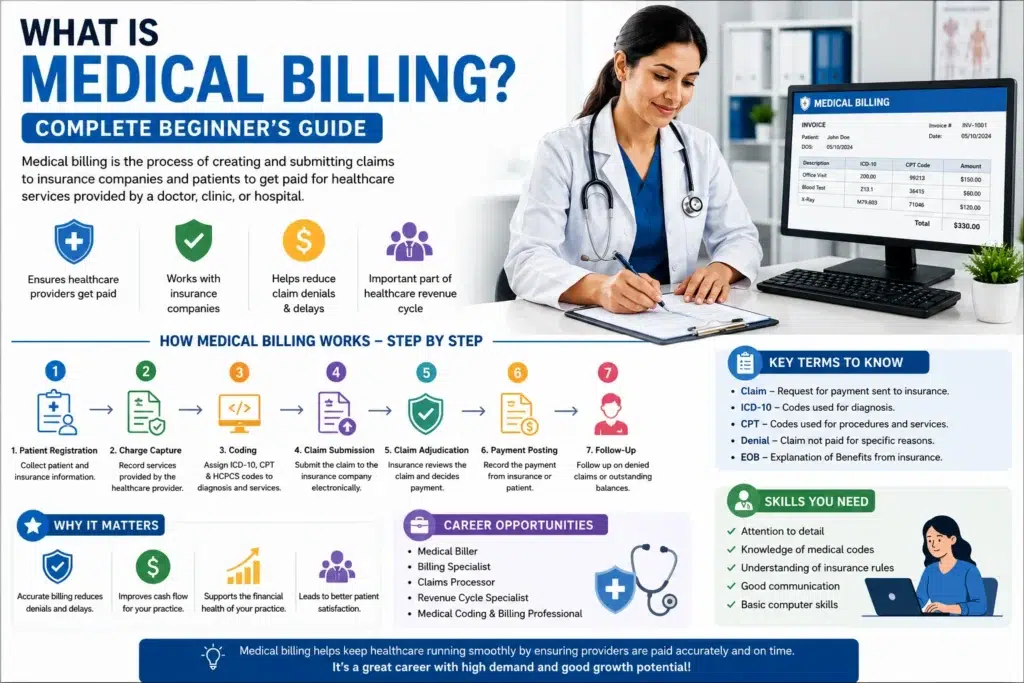
Many people think they go to the doctor, get checked and go back home. This is how healthcare practices run. But they never think about the behind-the-scenes administrative processes of each appointment that ensure healthcare providers get paid for the services they deliver. Here, they need to understand medical billing services.
Medical billing work is in the backend but it is one of the most important functions in modern healthcare. Without this, healthcare organizations are unable to run their practice as they don’t receive payments from insurance companies. Let’s show you what medical billing is and how medical billing works.
What Is Medical Billing?
Medical billing is the process of translating healthcare services into insurance claims and patient invoices so healthcare providers can receive payment for the care they provide.
In simple terms, when a patient visits a physician, receives treatment, undergoes diagnostic testing, or attends therapy sessions, someone must ensure that those services are accurately documented and submitted to the insurance company on time for reimbursement.
These responsibilities belong to the medical billing process.
Medical billers connect three entities: healthcare providers, insurance companies, and patients. They make sure providers receive their payment accurately and on time and help patients understand their financial responsibility. They also help insurance companies make the right coverage and approve the payment.
The major task of medical billing companies is to assign the accurate diagnostic code, check eligibility, submit claims, follow up on unpaid claims, appeal denials, and make sure the money owed to a practice shows up in the bank account.
Who's Involved in Medical Billing?
A few different people typically touch the billing process:
- Medical billers manage claim creation, submission, and follow-up.
- Medical coders assign the diagnosis and procedure codes (sometimes the same person handles both roles, especially in smaller practices).
- Front-desk and administrative staff handle registration and eligibility checks.
- Billing companies or RCM partners many practices outsource medical billing services so in-house staff can focus on patient care instead of chasing claims.
- Payers, the insurance companies themselves, who review and adjudicate every claim submitted.
Why Is Medical Billing So Important?
A hospital treats hundreds of patients every single day. Doctors perform surgeries, nurses administer medications, laboratories process blood work, and specialists provide consultations. Now what if all of these services are not billed accurately?
The hospital wouldn’t get paid.
Medical billing ensures healthcare organizations remain financially healthy so they can continue providing quality patient care. It seems a very simple process but in reality, medical billing tasks are more complex and challenging.
A single patient visit can generate a lot of individual data points, including diagnosis codes, procedure codes, modifiers, provider identifiers, insurance policy details and every one of them requires accuracy otherwise the claims get denied, delayed, or underpaid.
A clean billing process means faster payments, fewer denials, and a healthier revenue cycle overall. Healthcare practices must maintain this first pass clean claim rate.
The Medical Billing Process, Step by Step
Let’s discuss how does medical billing and coding work and what actually happens between a patient walking into a clinic and a claim getting paid.
Patient Registration
Before scheduling an appointment, front-desk staff collect the patient’s personal and insurance information, including name, date of birth, insurance ID, policy details, and so on. It’s not a simple process, as a lot of claims denials happen due to typos or missing details.
The best way to avoid these mistakes is to ask patients to verify their information at every visit, even if they’ve been coming to the clinic for years. Insurance plans and contact details can change, and keeping records up to date helps prevent unnecessary billing issues.
Insurance Verification and Eligibility Check
Next, someone confirms that the patient’s insurance is active and actually covers the service being provided. This step finds issues early, like an expired policy, copay amounts, deductibles, coinsurance, or a service that needs prior authorization before the patient even sees the provider.
Patient Visit and Medical Documentation
After insurance has been verified, the patient receives medical care. During the visit, the healthcare provider documents everything that happened from patient symptoms to follow-up recommendations. This documentation is the foundation for the entire billing process. That’s why it should be accurate.
If the documentation is incomplete or unclear, it becomes difficult to assign accurate medical codes or justify the services billed to insurance companies.
Medical Coding
Once the visit happens, the provider’s healthcare documentation must be translated into standardized codes. An experienced medical coder reviews the documentation and assigns ICD-10 codes for diagnoses and CPT or HCPCS codes for procedures and services. Here, healthcare practices need medical coding services that are closely relevant to medical billing but both are different.
Related Reading: If you want to know how medical billing services are different from medical coding, you can read our guide on Medical Billing vs. Medical Coding: What’s the Difference?
Charge Entry
The coded information gets entered into the billing system, along with the associated charges for each service. This creates the actual claim that’s about to be sent off.
Once coding is complete, the billing team enters all billable services into the practice management or billing software along with the associated charges for each service.
The billing software organizes this information into a claim format that insurance companies can process.
Accuracy at this stage is critical. Incorrect charge entry can cause underpayments, overpayments, or claim denials.
Claim Submission
Before submitting a claim, it must be reviewed. Many billing systems run automated claim-scrubbing tools to identify common errors such as missing information, invalid codes, or duplicate claims.
The claim goes off to the insurance payer, usually electronically through a clearinghouse. A clean claim that contains no errors gets submitted the first time and much faster than those that get rejected due to errors.
Payer Adjudication
The insurance company reviews the claim and decides how much they’ll pay based on the patient’s plan and coverage. Each claim gets different outcomes, as some get approved, approved with adjustments, a request for additional information, or denied.
Remember that denials do not mean the provider won’t get paid instead, they often require corrections and resubmission.
Payment Posting
Once the payer sends payment or an explanation of benefits explaining why they didn’t, the billing team records that information in the practice management system, and any remaining patient balance gets identified.
Accurate payment posting ensures financial records remain up to date and helps identify reimbursement trends.
Denial Management and Appeals
Claim denials are an unavoidable part of medical billing but effective denial management can recover a large portion of lost revenue. Rather than accepting denial, an experienced medical billing team starts working on it.
When a claim comes back denied, the professionals figure out why, fix the issue, and resubmit or appeal it. Tracking denial patterns also helps healthcare organizations improve their billing processes and reduce future errors.
In this stage, revenue either gets recovered or gets written off for good, depending on how smart the billing team is.
Patient Billing and Collections
After insurance has processed the claim, any remaining balance becomes the patient’s responsibility. Non-covered services include copays, deductibles, and coinsurance.
This step requires its own kind of expertise, as collecting from patients is a very different conversation than collecting from an insurance company.
Clear communication helps reduce confusion and encourages timely payments. Many healthcare providers now offer online payment portals, payment plans, and digital statements to make the process more convenient for patients.
Who Performs Medical Billing?
Medical billing can be handled in different ways. It depends on the size of the healthcare organization.
In-House Medical Billers
Many clinics employ dedicated billing specialists who work directly within the practice. In this way they have full control but requires hiring, training, and maintaining experienced staff.
Medical Billing Companies
Many providers choose the option of outsource billing to specialized medical billing companies.
These companies manage the entire revenue cycle and allow physicians to focus on patient care instead of administrative tasks.
Revenue Cycle Management (RCM) Teams
Larger hospitals typically have dedicated Revenue Cycle Management departments. RCM is not about billing; it’s the entire financial journey of a patient from scheduling an appointment to collecting the final payment. Medical billing is one of the most important components of Revenue Cycle Management.
The Connection Between Medical Billing and the Healthcare Revenue Cycle
Medical billing is often described as the backbone of the healthcare revenue cycle.
The revenue cycle includes every financial interaction between a patient and a healthcare provider, beginning before treatment even starts. An efficient revenue cycle ensures the insurance coverage is verified, healthcare services are provided, clinical documentation is completed, medical coding is assigned, claims are prepared and submitted, insurance reviews the claim, payment is issued, and any remaining patient balance is collected.
Every step depends on the previous one. A small error early in the process, such as incorrect insurance information or incomplete documentation, can delay reimbursement, making accuracy essential from start to finish.
Common Challenges in Medical Billing
Medical billing is not an easy field. Even with experienced staff and modern software, practices face billing challenges. Healthcare regulations frequently change, insurance policies change, and even small mistakes can impact reimbursement.
Some of the most common medical billing challenges include:
- Claim denials: Whether it’s a coding mismatch, missing prior authorization, or an eligibility issue, denials are one of the most common and most frustrating parts of billing. Every denied claim means delayed revenue and extra staff time to fix it.
- Constantly changing payer rules: Insurance companies update their requirements frequently and what worked last year might get a claim denied this year. That’s why staying current becomes a challenge.
- Provider enrollment issues: If a provider isn’t properly enrolled with a payer like Medicaid, claims can get rejected before they’re even reviewed. This is a bigger deal than people realize.
For more info, you can read the complete guide on How Medicaid Provider Enrollment Boosts Medical Billing Efficiency.
- Equipment and supply billing: Billing for durable medical equipment (DME) things like wheelchairs, oxygen equipment, or CPAP machines has its own set of rules and documentation requirements.
If your practice deals with DME at all, our post on The Role of DME in Healthcare in Efficient Medical Billing helps you understand what makes this category so different from standard billing.
- Staff turnover and training gaps: Billing requires ongoing training as codes, payer policies, and compliance requirements change constantly. A knowledge gap on the team can quietly cost a practice thousands of dollars in missed or delayed reimbursements.
Why Outsourcing Medical Billing Is Becoming So Common
A growing number of practices, especially smaller ones, are choosing to outsource their billing entirely rather than manage it in-house. An experienced medical billing and coding company has been working in this field for years. They have specialized knowledge, stay updated on constant regulatory changes, and have dedicated staff time.
If you want the best medical billing company, M&M Claims Care has been providing billing services for years. Our expert medical billers and coders know how to submit claims faster, handle denials, and improve the overall collection rate. With M&M Claims Care, your staff can focus on patients while giving you peace of mind. Book your free consultation today: +1 (267) 768-7915 and see how we boost your revenue cycle.