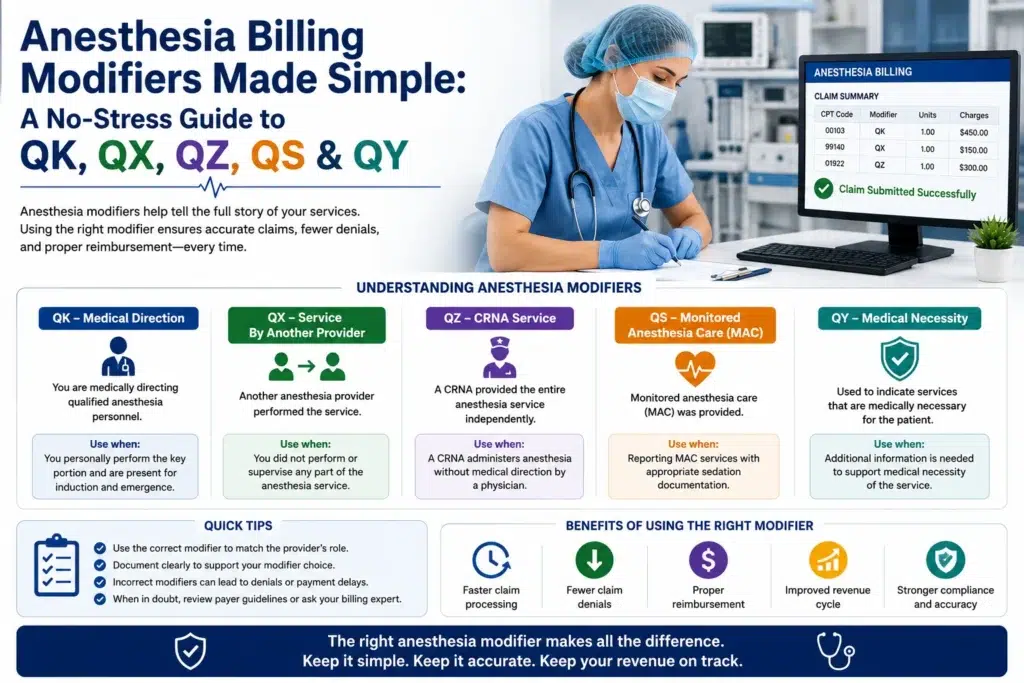
Anesthesia is a different specialty compared to other ones. It’s a process of medication that prevents patients from pain during different treatment procedures like surgeries, diagnostic tests, and screening. Anesthesia billing contains multiple codes and modifiers that make it more complex. For additional information about the procedure, anaesthesia modifiers help to ensure accurate and timely reimbursement. But for accurate billing operations, it is important to know the billing rules and guidelines for anesthesia care. So let’s discuss important anesthesia billing modifiers including AA, AD, QK, QX, QZ, QS, and QY so you get payment on time.
What Are Anesthesia Modifiers?
Modifiers are two-character codes that get added to CPT or HCPCS codes to give payers extra information. Anesthesia reimbursement is not calculated as CPT codes. Instead of using the direct code, payment is calculated as:
(Base Units + Time Units + Modifying Units) × Anesthesia Conversion Factor
The modifier you add not only describes the service but it can also change how much the insurance company pays. That’s why these two-character codes are so important. The same anesthesia service can be paid at 100% or only 50%, depending on who performed it and whether they were supervised.
The Q-modifiers we’re focusing on all relate to who provided the anesthesia service, whether it was an anesthesiologist, a CRNA (Certified Registered Nurse Anesthetist), or a combination of these two. These anesthesia modifiers help define things like:
- Medical direction (did an anesthesiologist supervise multiple CRNAs?)
- Medical supervision (was supervision more limited?)
- Independent work (was the CRNA working solo?)
- Hands-on vs. supervisory roles
Any inaccuracy during the usage of modifiers directly impacts your payment and can also trigger an audit.
From AA to QZ: What Each Anesthesia Modifier Actually Means
What is an AA Modifier?

AA modifier is applied when the anesthesiologists perform the entire anesthesia service themselves from start to end without help from a CRNA or resident.
When to use it:
Use AA only if the anesthesiologist handled the whole case alone. If a CRNA helped in any way, use the correct medical direction modifier like QK/QX or if the CRNA worked without medical direction then use QZ.
Claims with the AA modifier are usually paid at 100% of the allowed amount because the anesthesiologist provided the full service.
What is an AD Modifier?
Use AD when an anesthesiologist is supervising more than four anesthesia cases at the same time. In this situation, they cannot meet all the requirements for medical direction, so the case is billed as medical supervision instead.
When to use it:
Use AD if the anesthesiologist is supervising five or more CRNA or anesthesiologist assistant (AA) cases at the same time, or cannot meet all the medical direction rules.
Claims with the AD modifier are usually paid much less than medically directed cases. Many insurance companies pay only the base units and do not pay for time units. This makes AD one of the lowest-paying anesthesia modifiers.
What is QK Modifier?
The QK modifier is used when an anesthesiologist is medically directing two to four anesthesia procedures at the same time. That means they’re supervising two to four CRNAs (or AA’s Anesthesiologist Assistants) but not necessarily in the room the entire time. This modifier restricts 50% of the total amount that can be paid if the anesthesiologist or a certified registered nurse performs the procedure.
When to use it: If the anesthesiologist is overseeing multiple CRNAs and they meet all the seven steps of medical direction then you’ll use QK on the anesthesiologist’s claim and apply QX when the CRNA’s claim for the same case
Remember that only the anesthesiologist’s claim gets the QK. The CRNA’s claim gets QX (we’ll get to that next).
What is QX Modifier?
The QX modifier is used when a CRNA is working under medical direction from an anesthesiologist.
When to use it: If the anesthesiologist meets the required criteria (again, the seven steps) and the CRNA isn’t working independently, the CRNA’s claim gets QX. Both claims must match in the patient, date of service, and medical direction details to avoid claim denials.
Medicare typically splits the reimbursement 50/50 between the CRNA and the supervising physician in this scenario. So make sure both claims are submitted correctly!
What is QZ Modifier?
The QZ modifier is for when a CRNA performs the anesthesia case entirely on their own without medical direction or supervision from a physician.
When to use it: This modifier is applied in non-medically directed CRNA cases when the CRNA is doing it all themselves. Some states allow CRNAs to practice independently, but this depends on their scope of practice and state laws; this modifier reflects that autonomy.
QZ is an important modifier as it typically results in a full reimbursement for the CRNA and has no limits or effects on payment since no physician is involved. But make sure to check your state’s supervision laws as some states require physician oversight for Medicare to pay.
What is QS Modifier?
QS is a slightly different modifier. It doesn’t indicate who provided the anesthesia but rather what kind of anesthesia was delivered specifically, Monitored Anesthesia Care (aka MAC).
When to use it: Use the QS modifier when the provider performs Monitored Anesthesia Care (MAC) instead of general anesthesia. With MAC, the patient receives medication to help them relax but usually remains awake or only lightly asleep while the provider closely monitors their condition throughout the procedure.
The QS modifier does not affect payment by itself. It simply tells the payer that Monitored Anesthesia Care (MAC) was provided. The actual reimbursement depends on the other anesthesia modifier used on the claim, such as AA, QK, QX, or QZ.
What is QY Modifier?
QY is used when an anesthesiologist is only supervising one CRNA. It’s just like the QK modifier except it applies when the anesthesiologist is medically directing exactly one CRNA or AA rather than 2-4. It restricts 50% of payments between an anesthesiologist and CRNA.
When to use it: If the physician is medically directing just one case, not two to four like with QK, their claim gets QY and the CRNA’s claim still gets QX.
What Are Seven Steps of Medical Direction?
When anesthesiologists work with other, one or more qualified providers in overlapping cases then medical supervision occurs. There are seven steps specified by the American Society of Anesthesiologists and Medicare that are documented for anesthesiologists to bill. Both QK and QY require the physician to meet Medicare’s seven steps of medical direction. These steps help prove that the anesthesiologist was involved in patient care, even if they weren’t the one physically pushing meds. These seven steps include:
- Perform a pre-anesthetic exam and evaluation.
- Help create the anesthesia plan.
- Be physically present for induction and emergence (unless emergency prevents it).
- Monitor the course of anesthesia at frequent intervals.
- Stay immediately available for emergencies.
- Personally document post-anesthesia care.
- Ensure no more than four concurrent procedures are supervised.
If even one of these steps isn’t met then the anesthesiologist can’t bill with QK or QY. They might have to switch to a supervision modifier instead, like AD.
Documentation Payers and Auditors Look For
Anesthesia billing depends heavily on modifiers that’s why complete and accurate documentation is essential. It proves that the modifier you used is correct. Your records should include:
- Exact anesthesia start and end times, not rounded times
- Who provided the anesthesia and who supervised the case, if applicable
- Pre-anesthesia evaluation including the patient’s ASA physical status
- Monitoring notes recorded during the procedure
- Post-anesthesia note showing the patient’s condition when care was handed over
- For QK and QY claims, documentation that shows all seven medical direction requirements were met for each case
If the medical record doesn’t clearly show what happened, the claim directly goes into the denied claims even if the anesthesia care was provided correctly.
What Happens If You Get It Wrong?
Getting the modifiers wrong can lead to:
- Claim denials
- Delayed payments
- Underpayments
- Overpayments (which you’ll have to refund)
- Compliance red flags
In medical billing, accuracy matters, especially for efficient revenue cycle management. If you’re not sure which modifier to use then talk to the provider or check the medical record. It’s better to slow down and double-check than to deal with a denial or audit later.
Outsource your Medical Billing Operations
Accuracy is everything in medical billing but some healthcare providers cannot manage the complex billing tasks and as a result, fail to get reimbursement, which leads to losses. That’s why the best option providers have is to outsource their billing operations to an experienced medical billing company like M&M Claims Care. We know when and how to use these codes as we have processed thousands of claims of anesthesiologists. It’s time to become stress-free and get paid correctly, on time. Whether you need mental health billing services or urgent care billing services, M&M Claims Care is here for you.
Frequently Ask Questions
Anesthesia modifiers are two-character codes like AA, QK, or QZ added to anesthesia CPT codes to tell payers who performed the anesthesia service and how it was supervised. Because anesthesia reimbursement is calculated from base units, time units, and modifying units, the modifier directly affects how much of that formula actually gets paid.
Anesthesia modifiers fall into two groups: provider/supervision modifiers (AA, AD, QK, QX, QY, QZ), which describe who performed the anesthesia and what level of physician involvement occurred, and the service-type modifier (QS), which describes what kind of anesthesia was delivered like Monitored Anesthesia Care regardless of who performed it.
No. QZ is used when a CRNA works without medical direction. Whether it can be billed depends on state laws and the insurance payer’s policy. Always check both before using the QZ modifier.
QK is used when an anesthesiologist medically directs 2–4 concurrent cases and meets all required medical direction rules. AD is used when the anesthesiologist supervises more than four cases at the same time or cannot meet all the medical direction requirements. AD usually pays less than QK.
No. QS is an informational modifier that shows Monitored Anesthesia Care (MAC) was provided. It must be billed with another anesthesia modifier, such as AA, QX, or QZ, which determines the payment.