How much do medical billing services cost small practices in 2026-27?
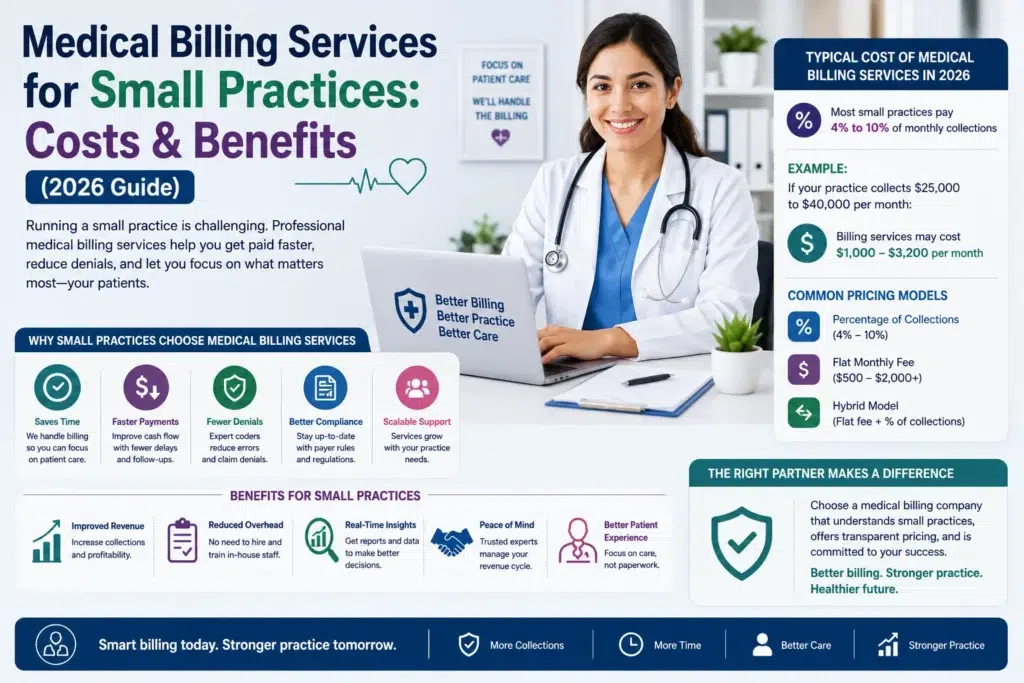
Most small practices pay 4% to 10% of their monthly collections for outsourced medical billing. For many practices, the cost is around 5% to 8%.
For example, if a practice collects $25,000 to $40,000 per month, billing services may cost about $1,250 to $3,200 per month. Some billing companies charge a flat monthly fee or a fee for each claim. These plans may cost around $300 to $2,500 per month or $3 to $12 per claim, depending on the practice size and specialty.
Running a small practice is more than a challenge because you have to manage two things separately. One is the care you provide and the second is the money you collect for it. You can deliver the best care but still lose 10–15% of revenue because of denied claims, underpayments, and unpaid bills that stay open for 90 days or more. That’s why they need the best medical billing services. And the affordable option is hiring a medical billing company. But as a small business owner, you don’t want to take risks and first ask How much does it cost, and is it worth it?
So let’s compare in-house billing with outsourced medical billing services and how much medical billing costs in 2026-27.
How Medical Billing Companies Charge: The 4 Pricing Models
Before comparing costs, you need to understand how medical billing companies charge. It depends on the pricing model and what services are included.
Percentage of Collections
The billing company charges a percentage of the money they collect for you. They are paid based on what you actually receive, not what you bill.
- Typical range: 4%–10% of collections
- Common range for small practices: 5%–8%
- The rate depends on: claim volume, specialty, denial rates, and what services are included
Ask whether the fee is based on gross charges or net collections. A 5% fee on gross charges can cost you more than an 8% fee on net collections because the amount you charge is usually much higher than what insurance companies actually pay.
Flat Monthly Fee
With this model, you pay a fixed amount every month. This fee usually covers a certain number of claims or providers.
- Typical range: 300–2,500 per month
- Best for: practices with high claim volume that want predictable costs
- Watch for: extra fees when you exceed the included claim limit and paying the same amount during slower months
Per-Claim Pricing
With this model, you pay a fixed amount for every claim the billing company submits. And it doesn’t matter how much the claim is worth.
- Typical range: 3–12 per claim
- Best for: practices with a high number of low-value claims where percentage-based pricing costs more
- Watch for: Some companies charge for every submission, like resubmitted or corrected claims. This can increase your costs if claims need to be fixed or sent again.
Hybrid Pricing
This model contains a flat monthly fee with a percentage of collections. For example, you pay $750 per month plus 3% of collections above a certain amount.
- Best for: practices that want predictable monthly costs while still using a performance-based pricing model
- Why it’s popular: It gives practices some cost stability without completely losing the benefits of percentage-based billing.
What Small Practices Actually Pay in 2026-27: Real Numbers
Based on current market pricing, the cost of outsourced medical billing services depends mainly on your practice size, monthly collections, specialty, and billing volume.
- Solo practices: If you collect around 20,000–40,000 per month then billing can cost about 1,000–3,200 per month or roughly 12,000–38,000 per year.
- Small groups (2–5 providers): Practices collecting 50,000–150,000 per month can pay around 2,500–12,000 per month.
- Flat-fee plans: Some solo practices pay about 300–1,200 per month, depending on the services and claim volume.
- Primary care and internal medicine: Billing rates are often around 5%–8% of collections.
- More complex specialties: Cardiology, orthopedics, and behavioral health can cost around 8%–12% because their billing can require more work.
For a practice collecting about $200,000 per year, outsourced billing can roughly cost 10,000–24,000 annually. And larger practices with higher claim volumes are able to negotiate lower rates that are sometimes around 4%–7%.
Why Specialty Changes the Price?
Your medical specialty can have a big impact on billing costs. Some specialties have simpler claims while others also need more coding, paperwork, and follow-up.
- Lower complexity (5%–8%): Primary care, family medicine, internal medicine, and pediatrics usually have simpler billing and fewer prior authorizations.
- Moderate complexity (7%–9%): Dermatology, urgent care, and general surgery require more coding and claim follow-up.
- Higher complexity (9%–12%): Cardiology, orthopedic surgery, OB-GYN, behavioral health, oncology, neurology, DME, and home health often involve more codes, prior authorizations, detailed documentation, and claim denials.
Affordable Medical Billing for Your Specialty
If you want an affordable specialty-based solution, M&M Claims Care is here for you. You get professional billing support without the high cost of maintaining a full in-house billing team. We offer our affordable solutions for specialties including:
- Mental Health billing services
- Acupuncture billing services
- Family Medicine billing services
- Cardiology billing services
- Urgent Care billing services
At M&M Claims Care, we provide the support your practice actually needs without the higher cost.
In-House Billing vs. Outsourced Billing: The Real Cost Comparison
Many practice owners compare in-house billing vs outsourced billing based on cost. But remember in-house billing is not free. You have to pay for salaries, benefits, software, training, and other costs. Let’s compare both expenses:
| Cost Factor | In-House Billing | Outsourced Billing |
|---|---|---|
| Salary + benefits (1 FTE biller) | $60,000–$80,000/year | Included in fee |
| Billing software / clearinghouse fees | $3,000–$10,000/year | Usually included |
| Ongoing coder training & certification | $1,000–$3,000/year per staff member | Included |
| Turnover / hiring / onboarding cost | Variable, often $5,000+ per replacement | None |
| Denial management expertise | Depends entirely on one employee’s skill | Dedicated team, cross-trained |
| Scalability during growth or provider turnover | Requires new hires | Scales with existing infrastructure |
| Typical annual cost, 2–10 provider practice | $60,000–$150,000+ | $12,000–$60,000 |
A solo in-house biller can cost 60,000–80,000 a year even when some claims are missed or denied. You can also lose money when the biller is sick, on vacation, or too busy to keep up with a high number of claims. If they leave, you also lose their experience and knowledge.
For practices with 2–10 providers, outsourcing billing can save around 50,000–100,000 a year after considering software, training, and hiring costs. For solo and small practices that collect less than about $1.5 million a year, outsourcing or using a hybrid billing model is often more affordable than keeping a full in-house billing team.
The Cost of Not Fixing Billing Problems
The comparison above only covers direct staffing costs. It doesn’t include the revenue leakage that happens when billing is under-resourced:
The comparison above only covers the direct staffing costs. It doesn’t include the revenue loss that happens when billing is poor.
- 20 denied claims worth about $210 each can mean $4,200 in lost revenue, plus the time needed to fix and resubmit them.
- Small practices with poor denial follow-up can lose 40,000–60,000 a year from claims that are never properly appealed or resubmitted.
- Fixing one denied claim can cost around 25–181 in staff time, depending on how complicated the claim is.
The main point is simple: the cost of billing is not just what you pay a biller. You also need to consider how much money your practice is losing because claims are denied, delayed, or never followed up.
Hidden Costs to Check Before You Sign
The price a billing company gives you does not include everything. Before signing a contract, ask if these costs are included:
- Setup and onboarding fees. Some companies charge 500–2,000 or more to get your practice started.
- Credentialing and payer enrollment. These services cost extra, sometimes for each insurance payer.
- Denial management. Make sure denied claims and appeals are included in the main fee instead of being charged separately.
- Patient statements. Some companies charge extra for creating and sending patient bills.
- Reports and analytics. Basic reports should usually be included. Custom reports may cost extra.
- Minimum monthly fees. Some companies have a minimum charge, so you can pay more during slow months.
- Contract and cancellation fees. Check how long the contract lasts and whether you have to pay a fee to cancel early.
These extra charges can increase your actual yearly cost by 15%–30%. So, don’t look at the percentage only. Ask for the total cost you will pay each year, including all fees.
The Benefits of Outsourcing Medical Billing for Small Practices
Cost is only one part of the decision. The question is how outsourcing can reduce claim denials and improve collections?
Let’s show you how a billing service helps your practice collect more money, save time, and reduce billing problems.
Fewer Denials and Faster Payments
A professional medical billing team knows which factors are important for successful claim submission. They check claims for coding mistakes, insurance issues, and payer requirements before submitting them. This can help reduce denied claims and get payments to your practice faster. In 2026-27, the average claim denial rate is around 8%-12% while well-managed billing processes can keep denials below 5%.
Faster Accounts Receivable (AR)
The main goal of running a healthy practice is around 30–40 days in accounts receivable (AR). When unpaid claims stay open for more than 50 or 60 days, it can be a sign that billing problems need attention. A dedicated billing team regularly tracks unpaid claims, denials, and delayed payments to help keep your AR under control.
More Staff Time for Patient Care
When your front-desk or clinical staff have to spend hours checking claims and following up on unpaid bills, they have less time for patients. Outsourcing billing takes this work and allows your staff to focus more on patient care, scheduling, and daily practice operations.
Specialized Expertise Without the Hiring Risk
Medical billing rules change often. CPT and ICD-10 codes, insurance requirements, prior authorization rules, and CMS payment rates can all change throughout the year. An outsourced billing team keeps up with these changes as part of their job. With an in-house biller, the practice usually has to pay for ongoing training and if that employee leaves, their knowledge goes with them.
Easy to Scale
Outsourced billing can grow with your practice. If you add a new provider, open another location, or suddenly see more patients, you usually don’t need to hire and train another biller. Your billing company can handle the additional claim volume.
Better Financial Visibility
A good billing company provides regular reports on collections, denied claims, and unpaid accounts. This helps practice owners understand how their billing is performing and where money is getting stuck.
Helps Reduce Compliance Risks
Billing mistakes can cause more than lost revenue. Incorrect codes, missing documentation, and other errors can lead to payer audits and compliance problems. An experienced billing team follows consistent billing procedures to help reduce these risks.
When Should a Small Practice Outsource Medical Billing
You don’t have to wait until your practice has a serious cash-flow problem to review your billing. It is time to consider a change if denials are increasing, unpaid claims are staying open for 60–120 days, or claims are not being submitted on time. You should also take a closer look if most of your billing knowledge depends on one employee or if your staff spend too much time dealing with insurance issues instead of helping patients. And if you don’t know your denial rate, clean-claim rate, or Days in AR, that’s another sign your billing process needs attention.
If you face two or more of these problems in your practice, then the cost of not addressing billing is higher than the cost of outsourcing it.
How to Choose the Right Medical Billing Partner
When you choose a medical billing company, price should not be the only thing you consider. A company charging 5% with poor claim results could cost you more than one charging 8% with strong results.
So look at what you are actually getting for the price. Make sure the base fee includes denial management, AR follow-up, appeals, and regular reporting. Also, confirm whether the percentage is based on gross or net collections and ask for the company’s actual clean-claim and first-pass resolution rates. It’s also important to choose a company that has experience with your specialty and its specific billing requirements.