What Are HCPCS Codes?
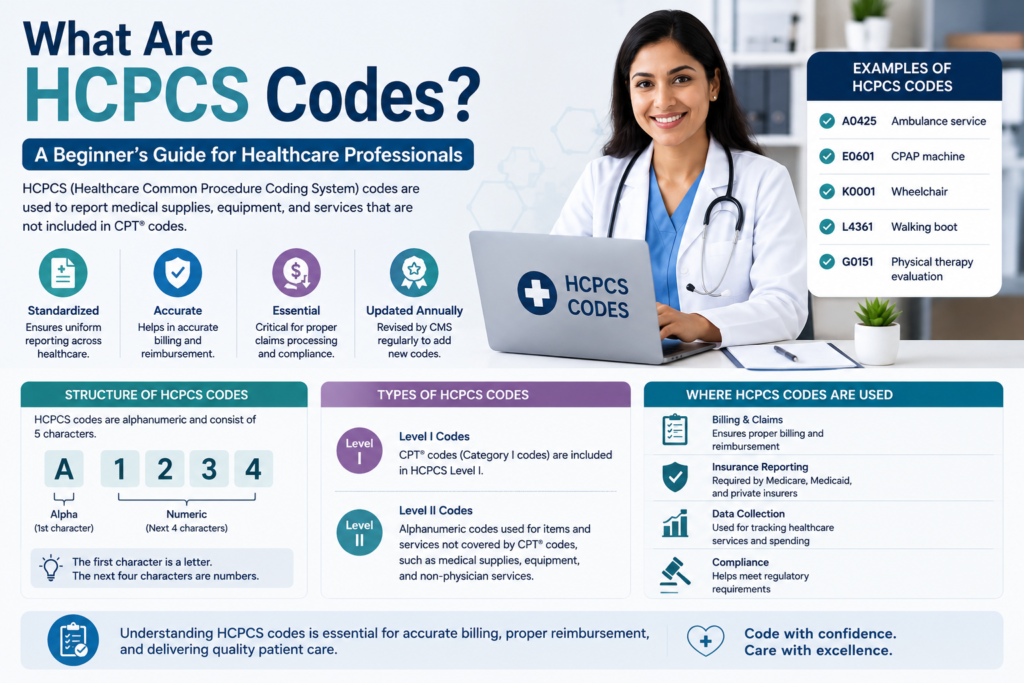
Quick answer: HCPCS, which is pronounced as hick-picks and stands for the Healthcare Common Procedure Coding System. It’s a standardized set of alphanumeric codes used to bill Medicare, Medicaid, and many private payers for medical procedures, supplies, equipment, and services, especially items that CPT codes don’t cover, like ambulance rides, wheelchairs, and injectable drugs.
The HCPCS system is maintained by the Centers for Medicare & Medicaid Services (CMS) and used for one reason: to give every provider, supplier, and payer in the U.S. healthcare system a common language. Without it, a hospital and an insurer would have no consistent way to describe the same wheelchair, the same ambulance transport, or the same wound care supply on a claim.
HCPCS codes are important for almost every role in the revenue cycle:
- Providers use them to document what was actually performed or supplied.
- Coders translate the provider’s documentation into the correct code.
- Billers attach those codes to claims and submit them to payers.
- Payers use the codes to check medical necessity and calculate reimbursement.
If any link in that chain uses the wrong code or an outdated one then the claim can be denied, delayed, or underpaid.
A Short History: Why HCPCS Exists
HCPCS was introduced in the late 1970s by what was then called the Health Care Financing Administration (HCFA), the agency that later became CMS. At the time, CPT codes were already used for physician services. But still, there was no standardized way to bill Medicare for the supplies, equipment, and non-physician services that were used with patient care, things like ambulance transport, prosthetics, or a hospital bed for home use.
CMS built HCPCS to fill that gap and introduced Level I of the system that uses the same codes as CPT for medical procedures and services. Level II was created for items and services that CPT does not cover like durable medical equipment (DME), orthotics, prosthetics, medical supplies (DMEPOS), certain medications, and services provided by non-physician healthcare professionals.
There was also a Level III, which allowed state Medicaid programs and regional insurers to create their own local codes. But CMS discontinued Level III in 2003 to create one national coding system under HIPAA. Today, only Level I and Level II HCPCS codes are used.
HCPCS Level I vs. Level II: What's the Difference?
Quick answer: HCPCS Level I is just like CPT, having five-digit numeric codes maintained by the American Medical Association for physician and clinical services. HCPCS Level II is a separate alphanumeric code set containing one letter with four numbers maintained by CMS for equipment, supplies, drugs, and services CPT doesn’t cover.
HCPCS Level I
- Format: Uses 5 numeric digits like 99213.
- Maintained by: The American Medical Association (AMA).
- Covers: Physician services, office visits, surgeries, and laboratory tests.
- Updated: Once a year.
- Also known as: CPT codes.
HCPCS Level II
- Format: Uses 1 letter followed by 4 numbers like E0143.
- Maintained by: The Centers for Medicare & Medicaid Services (CMS).
- Covers: Durable medical equipment (DME), prosthetics, orthotics, medical supplies, ambulance services, certain drugs, and some dental services in coordination with the ADA.
- Updated: Drugs and biologicals are updated quarterly while most other code categories are updated twice a year.
- Also known as: HCPCS codes or national codes.
People often use the term “HCPCS codes” to refer only to Level II HCPCS codes, even though HCPCS actually includes both Level I and Level II. This is because Level I is simply the CPT code set under the HCPCS system. While the difference seems minor, understanding which level you’re referring to is important when searching for codes, training staff, or preparing medical documentation, as it helps avoid confusion and coding errors.
How a HCPCS Level II Code Is Built
As we’ve already discussed, every HCPCS Level II code has five characters consisting of one capital letter followed by four numbers, for example, A4351 or E0470. The first letter shows the general category of the item or service, so experienced coders can often tell what the code is related to just by looking at that letter.
Just like CPT codes, HCPCS Level II codes can also include modifiers to provide extra details without changing the main code. For example, a modifier can indicate which side of the body a service was performed on or show that a supply was provided under a specific program. These modifiers are usually two additional letters, numbers, or a combination of both added to the end of the HCPCS code.
Common HCPCS Level II Codes
Healthcare professionals use HCPCS codes list regularly, including:
- A4253: Blood glucose test strips
- E0114: Crutches
- E0601: CPAP device
- J1885: Ketorolac injection
- J3490: Unclassified drugs
- L3908: Wrist-hand orthosis
- Q9967: Contrast material
- G0463: Hospital outpatient clinic visit
- K0001: Standard wheelchair
- A4604: Tubing for CPAP device
Each code tells the payer exactly what item or service was provided.
The HCPCS Level II Letter Categories, Explained
HCPCS Level II codes are grouped by their first letter, which indicates the general type of item or service. Knowing these categories makes it easier to identify the correct code and find possible coding mistakes.
- A Codes: Medical and surgical supplies, ambulance and transportation services, and some miscellaneous services.
- B Codes: Enteral and parenteral nutrition including tube feeding and IV nutrition supplies.
- C Codes: Hospital outpatient procedures and new technologies billed under the OPPS.
- D Codes: Dental procedures coordinated with the ADA’s dental coding system.
- E Codes: Durable medical equipment (DME) like wheelchairs, walkers, and hospital beds.
- G Codes: Temporary procedure and professional service codes that do not yet have a permanent CPT code.
- H Codes: Alcohol and drug abuse treatment services, mainly used by state Medicaid programs.
- J Codes: Injectable drugs, chemotherapy medications, and other drugs that are not taken by mouth.
- K Codes: Temporary codes for durable medical equipment used by Medicare DME contractors.
- L Codes: Orthotic and prosthetic devices and related services.
- M Codes: Miscellaneous medical services including certain screening services.
- P Codes: Pathology and laboratory services.
- Q Codes: Temporary codes for new drugs, biological products, and other items while CMS decides on a permanent code.
- R Codes: Diagnostic radiology services including portable imaging equipment transportation.
- S Codes: Codes used by private insurance companies and some state Medicaid programs. These are not accepted by Medicare.
- T Codes: Codes created specifically for state Medicaid programs.
- V Codes: Vision and hearing services including eyeglasses, contact lenses, and hearing-related items.
You don’t need to memorize every HCPCS category. But knowing the letter groups can help you quickly identify coding errors. For example, if a medical supply is billed with a J code, it’s likely incorrect because J codes are reserved for injectable drugs, not supplies.
Why HCPCS Codes are Important for Reimbursement
Quick answer: Accurate HCPCS coding is essential because it directly affects whether a claim is approved, delayed, or denied. Insurance payers use HCPCS codes to verify medical necessity, determine the correct reimbursement, and confirm that the services or supplies billed match the medical documentation.
Using the wrong or outdated HCPCS code can create different problems for your revenue cycle management, including:
- Claim denials: Invalid or deleted codes are mostly rejected automatically before a claim is reviewed.
- Lower reimbursement: Choosing a less specific code can result in being paid less than the actual value of the service or item provided.
- Compliance issues: Repeated coding mistakes can cause payer audits and increase compliance risks.
- Payment delays: Denied or pending claims take longer to process and slow down cash flow for healthcare providers.
Because HCPCS codes change regularly so it is important for billing teams to stay up to date. CMS updates Level II codes quarterly for drugs and biological products and at least twice a year for most other categories. New codes are added, existing code descriptions are revised, and outdated codes are removed. As a result, a code that was valid last year no longer is valid for claims submitted this year. Keeping current with these updates helps reduce claim errors and ensures faster and more accurate reimbursement.
What Changed in the 2026 HCPCS Update
HCPCS Level II codes are updated regularly, so it’s important to use the correct code for the date the service was provided. In the January 2026 update, CMS introduced about 160 new codes, deleted around 101 codes, and revised nearly 300 code descriptions across different code groups including A, C, G, J, Q, and S.
These updates include:
- New A-codes (A4295–A4297): This code is added for intermittent urinary catheters with a hydrophilic coating and give these products their own specific billing codes.
- New C-codes: CMS introduced 19 new C-codes for hospital outpatient services and durable medical equipment, including a code for an implantable integrated neurostimulator.
- New G-codes: Additional G-codes were created to support psychiatric collaborative care management and reflect the growing use of team-based behavioral health services.
These updates show why billing teams must review HCPCS changes regularly. If a claim for a service provided on or after January 1, 2026 uses a code that was deleted or replaced, the claim can be rejected and lead to payment delays. Staying current with HCPCS updates helps reduce claim denials and ensures accurate reimbursement.
HCPCS vs. CPT vs. ICD-10-CM
In medical billing, only three coding systems exist that work together but the purpose of each system is different.
- ICD-10-CM: Explains why the patient needed care. It is used to report the patient’s diagnosis or medical condition.
- CPT (HCPCS Level I): Describes what the healthcare provider did such as an office visit, surgery, or medical procedure.
- HCPCS Level II: Identifies the supplies, medical equipment, drugs, or other non-physician services provided that are not covered by CPT.
In many healthcare claims, all three code sets are used together. For example, an ICD-10-CM code identifies the patient’s diagnosis, a CPT code reports the procedure performed by the provider, and a HCPCS Level II code bills for related items such as medical supplies, durable medical equipment, or injectable medications.
Understanding how these coding systems work together is essential for accurate billing, fewer claim denials, and proper reimbursement.
How M&M Claims Care Helps Practices Stay Ahead of HCPCS Changes
Accurate coding plays a major role in keeping your practice’s cash flow healthy, and HCPCS coding is an important part of that process. But to use these codes accurately, you need the best medical billing partner who knows how to keep updated with these coding guidelines. And there’s no better choice than M&M Claims Care.
Our billing and coding team stays up to date with every CMS quarterly and annual HCPCS update. We update our claim review process before new codes take effect and verify that documentation matches the latest HCPCS requirements. For practices that regularly bill durable medical equipment (DME), injectable drugs, or outpatient supplies, our proactive approach helps reduce claim denials, improve first-pass claim acceptance, and speed up reimbursement. We work for your practice and take complete responsibility for your revenue cycle management. So without wasting time, get your medical billing audit for free.