
Choosing the right ICD-10 codes for acupuncture is the difference between a paid claim and a denial letter. Acupuncture itself is reported with CPT codes 97810–97814 but the diagnosis code is what tells the payer why the needling was medically necessary. Let’s discuss ICD-10-CM codes for chronic pain, back pain and neck pain in detail.
Quick Answer: Which ICD-10 Codes Support Acupuncture Claims?
- Back pain: The main codes include M54.50 (unspecified low back pain), M54.51 (vertebrogenic low back pain) and M54.59 (other low back pain). Medicare also uses these codes with certain lumbar and lumbosacral disc degeneration codes, such as M51.360–M51.362 and M51.370–M51.372 for acupuncture coverage.
- Neck pain: M54.2 (neck pain) is the main code. Other codes, such as M54.12, M50.-, M47.812, M53.0, M53.1, M99.01, S13.4XXA and S16.1XXA, cover conditions like nerve pain, disc problems, joint issues, whiplash and muscle strain. Original Medicare does not cover acupuncture for neck pain but many private insurance plans do.
- Chronic pain: G89.29 (other chronic pain), G89.21 (chronic pain due to injury) and G89.4 (chronic pain syndrome) help describe long-term pain. These codes should be used with the code that identifies the affected body area, not as a replacement.
- CPT codes: Always use the correct CPT code (97810, 97811, 97813 or 97814) with the diagnosis code. Make sure the provider’s notes clearly support all codes listed on the claim.
Why ICD-10 Codes Decide Whether Acupuncture Claims Get Paid
Every acupuncture claim includes a procedure code and a diagnosis code. Insurance companies check whether the diagnosis is covered under their policy. If it is not on the approved list, the claim can be denied before anyone reviews the medical records. For example, Cigna denies acupuncture claims that use diagnosis codes not covered under its policy. Medicare also follows specific coverage rules but it covers acupuncture for only one condition: chronic low back pain.
Three important rules apply when choosing diagnosis codes:
- Provider documentation comes first. Always choose the diagnosis code based on the provider’s notes confirming the patient’s condition.
- Use the complete code. Always report the full ICD-10-CM code. For example, M54.5 is no longer valid. From October 1, 2021, you must use M54.50, M54.51 or M54.59.
- Check the date of service. Always use the ICD-10-CM code set that applies to the service date. The FY 2027 code set applies to services provided between October 1, 2026 and September 30, 2027.
Acupuncture CPT and HCPCS Codes You Will Pair With ICD-10
Code | Description | Type | Billing note |
97810 | Acupuncture, 1 or more needles without electrical stimulation, initial 15 minutes of one-on-one contact | Primary | Only one initial code (97810 or 97813) per date of service |
97811 | Each additional 15 minutes without electrical stimulation with re-insertion of needle(s) | Add-on | Reported with 97810 |
97813 | Acupuncture, 1 or more needles with electrical stimulation, initial 15 minutes of one-on-one contact | Primary | Only one initial code per date of service |
97814 | Each additional 15 minutes with electrical stimulation with re-insertion of needle(s) | Add-on | Reported with 97813 |
20560 | Needle insertion(s) without injection, 1 or 2 muscles (dry needling) | Primary | Counts as a session under NCD 30.3.3; not on the same date as 97810–97814 |
20561 | Needle insertion(s) without injection, 3 or more muscles (dry needling) | Primary | Same rules as 20560; report 20560 or 20561, not both, on one date |
Acupuncture time codes are paid in 15-minute units of personal, one-on-one contact, not by how long the needles stay in place. If you need a refresher on how these procedure codes fit the wider coding system, see our beginner’s guide to HCPCS codes.
Medicare Coverage for Acupuncture: NCD 30.3.3 Explained
Since January 21, 2020, Original Medicare has covered acupuncture only for chronic low back pain (cLBP) under National Coverage Determination (NCD) 30.3.3. It does not cover acupuncture for other conditions, such as neck pain, fibromyalgia or osteoarthritis. CMS also considers dry needling a type of acupuncture under this policy.
How CMS Defines Chronic Low Back Pain
The patient’s low back pain must meet all of the following:
- Lasting 12 weeks or longer
- Nonspecific, meaning no identifiable systemic cause such as metastatic, inflammatory or infectious disease
- Not associated with surgery
- Not associated with pregnancy
ICD-10-CM does not set a specific time limit for when pain becomes chronic. The provider must clearly document that the pain is chronic. For Medicare acupuncture coverage, the medical notes must also show that the patient has had low back pain for at least 12 weeks. The diagnosis code alone cannot prove this requirement.
Visit Limits, Modifiers and Frequency Edits
- Initial visits: Medicare covers up to 12 acupuncture visits within 90 days.
- Additional visits: Patients may receive 8 more visits if they show improvement.
- Annual limit: Medicare covers a maximum of 20 acupuncture treatments per year.
- Modifier KX: Add modifier KX to claims for visits 13 through 20.
- What counts as one session: Since January 1, 2024, one session includes one initial acupuncture code (97810 or 97813), with or without add-on codes on the same date. One dry-needling code (20560 or 20561) also counts as one session.
- Same-day billing: Acupuncture and dry needling cannot be billed on the same date.
- When to stop treatment: Stop treatment if the patient is not improving or their condition is getting worse.
Who Can Provide and Bill Medicare Acupuncture?
Physicians can provide acupuncture if they meet their state’s requirements. Physician assistants, nurse practitioners, clinical nurse specialists and support staff can also provide it if they meet the required qualifications. They must have a master’s or doctoral degree in acupuncture or Oriental medicine from an ACfiAOM-accredited school and a current, unrestricted state license. Support staff must also work under the supervision rules in 42 CFR 410.26 and 410.27.
Medicare does not recognize licensed acupuncturists as independent providers so they cannot bill Medicare directly. However, they can provide acupuncture under a physician or qualified non-physician practitioner. The supervising provider must submit the Medicare claim.
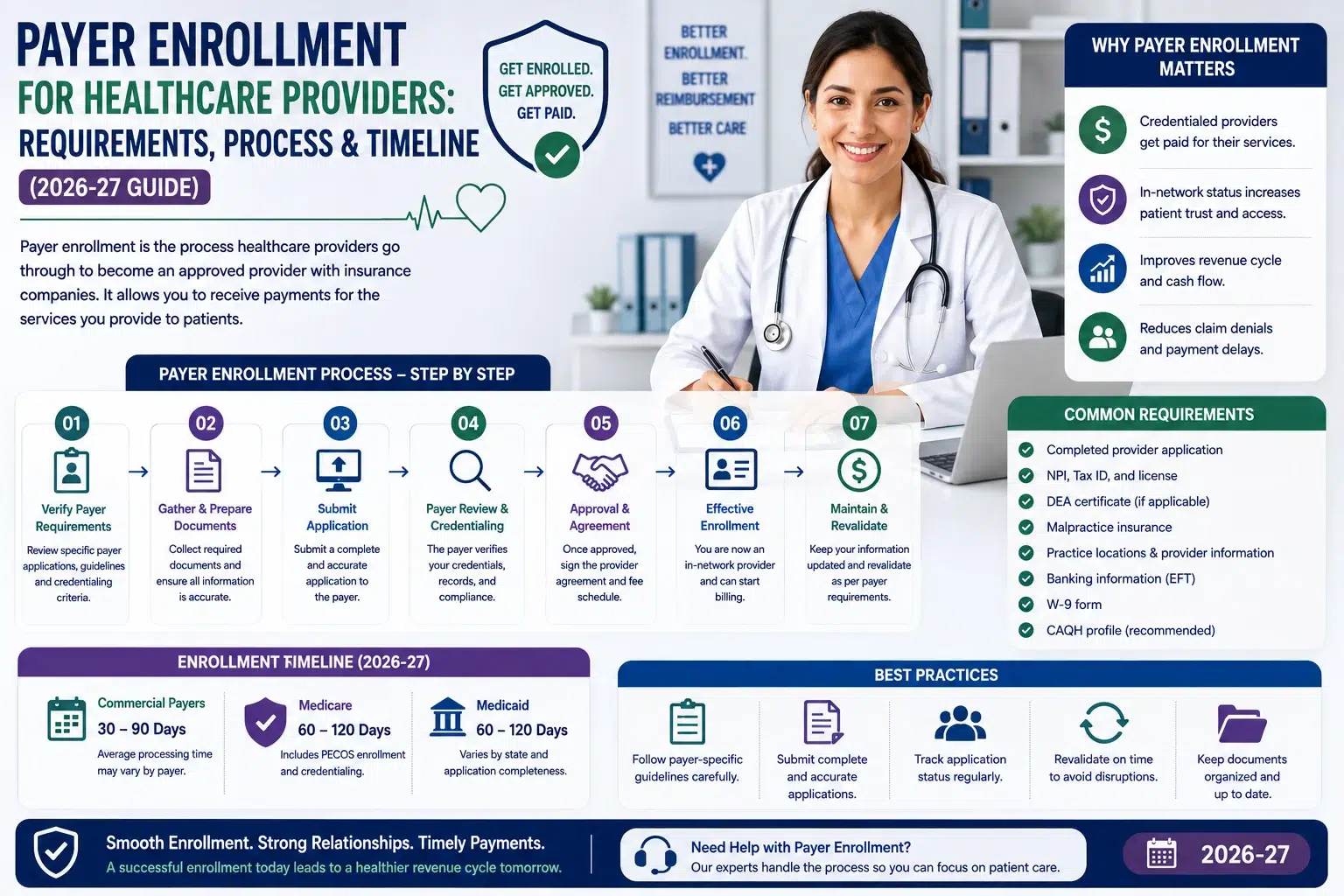
If your practice needs help with enrollment before billing, our payer enrollment guide explains the process.
ICD-10 Codes for Acupuncture for Back Pain
Low Back Pain Codes (M54.5-)
On October 1, 2021, the old code M54.5 was deleted and replaced by three five-character codes.
Code | Description | Use when the provider documents… | Medicare cLBP benefit |
M54.50 | Low back pain, unspecified | Low back pain with no further type specified | Accepted by many payers and Medicare Advantage plans. Sources conflict on whether it sits on CMS’s list, so confirm against your MAC’s current NCD 30.3.3 code list |
M54.51 | Vertebrogenic low back pain | Pain attributed to vertebral endplate pathology | Yes, added by CMS effective October 1, 2021 |
M54.59 | Other low back pain | Another specified type of low back pain | Yes, added by CMS effective October 1, 2021 |
M51.360–M51.362 | Other intervertebral disc degeneration, lumbar region (discogenic back pain only / lower extremity pain only / both) | Disc degeneration with discogenic pain | Listed in payer policies that mirror CMS’s list since the October 1, 2024 code expansion |
M51.370–M51.372 | Other intervertebral disc degeneration, lumbosacral region (same three variants) | Disc degeneration with discogenic pain | Same as above |
As of October 1, 2024, M51.36 and M51.37 are no longer valid billable codes. They have been replaced with more specific six-character codes. Any billing template, saved code list or superbill that still uses the old codes may result in claim denials.
Other Back Pain Codes Commercial Payers Commonly Accept
Cigna’s April 2026 acupuncture policy lists the following codes as supporting medical necessity when its coverage requirements are met. However, these codes do not qualify patients for Medicare’s chronic low back pain (cLBP) benefit.
- M54.6 – Thoracic spine pain: Used for pain in the middle or upper back.
- M54.9 – Unspecified back pain: Used when back pain is documented but the affected area is not specified.
- M54.89 – Other back pain: Used for other specified types of back pain.
- M54.30–M54.32 – Sciatica: Used for pain caused by sciatic nerve irritation. The code identifies whether the affected side is unspecified, right or left.
- M54.40–M54.42 – Low back pain with sciatica: Used when a patient has both lower back pain and sciatica.
- M47.816 and M47.817 – Lumbar and lumbosacral spondylosis: Used for degenerative changes in the lumbar or lumbosacral spine without myelopathy or radiculopathy.
- M48.061 – Lumbar spinal stenosis: Used when narrowing of the spinal canal is documented in the lumbar region without neurogenic claudication.
- M99.03 – Lumbar segmental dysfunction: Used for joint and movement-related dysfunction in the lower back.
- S39.012A – Lower back muscle strain: Used for an initial encounter involving a strain of the muscles, fascia or tendons in the lower back. The required seventh character identifies the type of encounter.
ICD-10 Codes for Acupuncture for Neck Pain
Original Medicare does not cover acupuncture for neck pain under NCD 30.3.3. Coverage under private insurance plans depends on the member’s benefits and the insurer’s policy. For example, Cigna can cover acupuncture for joint, muscle and soft-tissue pain, including neck and back pain, when it affects daily activities and the member’s plan includes acupuncture benefits.
Code | Description | Use when |
M54.2 | Cervicalgia | Neck pain with no more specific diagnosis. Excludes1 note: cervicalgia due to cervical disc disorder (M50.-) |
M54.12 | Radiculopathy, cervical region | Nerve-root symptoms radiating into the shoulder or arm |
M50.120–M50.123, M50.20–M50.23, M50.30–M50.33 | Cervical disc disorder with radiculopathy (mid-cervical), other cervical disc displacement, other cervical disc degeneration | A cervical disc condition is the documented source of pain |
M47.812 | Spondylosis without myelopathy or radiculopathy, cervical region | Degenerative cervical joint disease |
M53.0 | Cervicocranial syndrome | Neck pain with headache or dizziness features documented as a syndrome |
M53.1 | Cervicobrachial syndrome | Neck pain with shoulder and arm symptoms documented as a syndrome |
M99.01 | Segmental and somatic dysfunction of cervical region | Cervical joint dysfunction |
S13.4XXA | Sprain of ligaments of cervical spine, initial encounter | Whiplash-type sprain (7th character A, D or S per Chapter 19 rules) |
S16.1XXA | Strain of muscle, fascia and tendon at neck level, initial encounter | Acute neck muscle strain (7th character required) |
M79.12 | Myalgia of auxiliary muscles, head and neck | Muscle pain documented in neck and head muscles |
Neck Pain Coding Rules That Prevent Denials
To avoid neck pain coding denials, use the code that describes the actual cause of the condition, not just the symptom. Choose the correct 7th character for injury codes based on the stage of treatment. Keep clear records of the patient’s functional limitations and progress, including range of motion or Neck Disability Index results. For Medicare patients, explain that acupuncture for neck pain is not covered and discuss payment responsibilities before treatment.
ICD-10 Codes for Chronic Pain (Category G89)
Category G89 (pain, not elsewhere classified) lets you tell the payer that the pain is chronic, but it works as a supplement.
Code | Description | Best use |
G89.29 | Other chronic pain | Chronic pain documented without a trauma, procedure or cancer cause |
G89.21 | Chronic pain due to trauma | Chronic pain that follows an injury |
G89.28 | Other chronic postprocedural pain | Chronic pain after a procedure |
G89.3 | Neoplasm related pain (acute) (chronic) | Cancer-related pain |
G89.4 | Chronic pain syndrome | Only when the provider documents chronic pain syndrome |
Official Guideline Rules for G89 Codes
FY 2027 ICD-10-CM guidelines allow G89 codes to be used with other diagnosis codes to describe acute or chronic pain. Use them only when the provider clearly documents the pain as acute or chronic. There is no fixed time limit for chronic pain. If the visit focuses on treating an underlying condition, code that condition first. G89 codes can be listed first when the visit is specifically for pain management.
For acupuncture billing: G89.29 alone does not qualify a patient for Medicare’s chronic low back pain benefit. For commercial insurance, G89 codes may support the claim when the payer accepts them. Always include the site-specific diagnosis code and document the pain’s duration, severity and effect on daily activities.
How Acupuncture Coverage and ICD-10 Requirements Differ by Payer
- Original Medicare (Part B): Covers acupuncture only for chronic low back pain under NCD 30.3.3. Claims require eligible low back pain or listed lumbar disc degeneration codes, along with documentation of pain lasting at least 12 weeks. Medicare allows 12 visits in 90 days, with up to 8 additional visits and a maximum of 20 per year. Modifier KX is required for visits 13–20. Licensed acupuncturists cannot bill Medicare directly.
- Medicare Advantage: Must cover at least what Original Medicare covers but some plans offer additional acupuncture benefits. Chronic low back pain follows Medicare’s coverage rules while extra benefits depend on the individual plan. Coverage can change each year.
- Commercial Insurance (Cigna as an example): Can cover acupuncture for joint, muscle and soft-tissue pain, including spinal pain that affects daily activities. Some plans also cover headaches and certain types of nausea. Accepted diagnosis codes include M54.-, M50.-, M47.-, M53.-, M99.- and G89.-. Coverage depends on the member’s benefits and continued treatment requires measurable improvement.
- Medicaid: Acupuncture coverage depends on the state. Each state has its own approved diagnosis codes, coverage rules and visit limits. Always check the state Medicaid provider manual.
Important: Every payer has different coverage rules. Verify the patient’s benefits and approved diagnosis codes before the first visit. Then prepare claims according to that payer’s requirements instead of using one coding approach for every plan.
How M&M Claims Care Helps Reduce Acupuncture Claim Denials
M&M Claims Care is an experienced medical billing company that helps acupuncture and pain-management practices simplify billing, avoid coding errors and get claims paid faster.
M&M Claims Care provides reliable acupuncture billing services, helping practitioners manage claims, reduce denials, and improve revenue cycle performance. Our team handles acupuncture billing diagnosis and procedure code checks, claim submission, denial follow-ups, payer enrollment and regular code updates. We make sure your claims follow payer requirements so you can spend less time on billing and more time caring for patients.
Ready to reduce acupuncture claim denials? Contact M&M Claims Care today for a no-obligation review of your billing process.