Many healthcare organizations lose a surprising amount of revenue every year without even realizing it. This hidden loss is known as revenue leakage, which has become one of the biggest challenges for healthcare providers. It quietly affects profits, reduces cash flow, and creates unnecessary stress for physicians, administrators, and billing teams.
Most revenue leakage happens due to small operational mistakes that are ignored until they start affecting the practice’s revenue cycle. Let’s show you what revenue leakage in healthcare is, why it happens, and how healthcare providers can prevent it.
What Is Revenue Leakage in Healthcare?
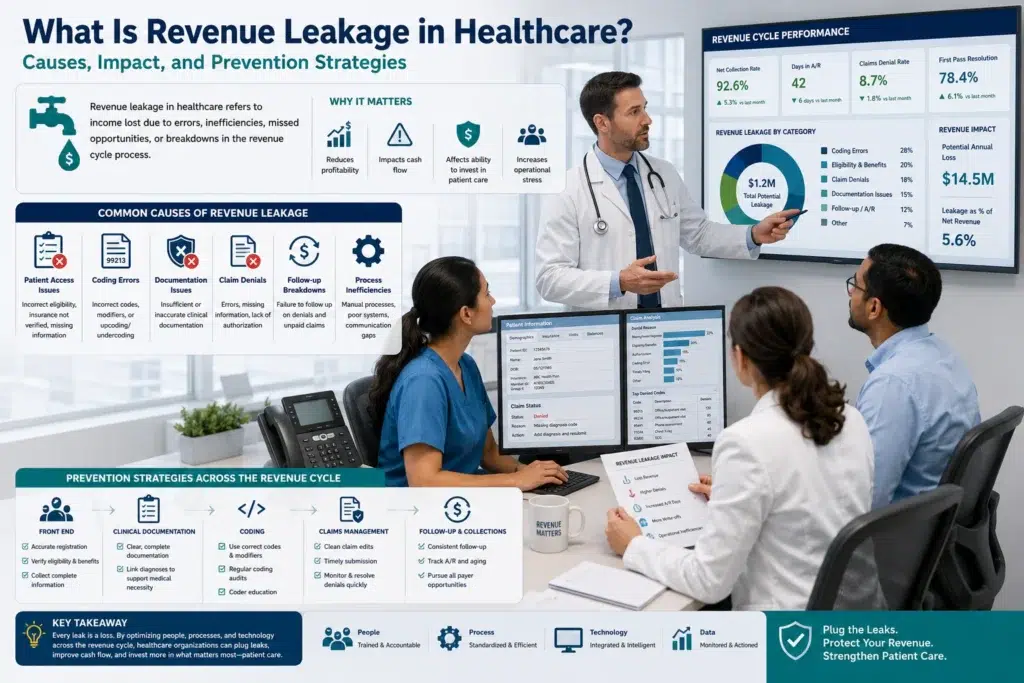
The meaning of Revenue leakage is the loss of revenue that a provider has earned but fails to collect, not because services weren’t delivered, but because of errors, inefficiencies, or any missing steps in the billing and reimbursement process. Simply put, it’s money that a healthcare practice has earned but never collects.
Revenue leakage occurs due to billing errors, inefficiencies, coding mistakes, claim denials, underpayments, uncollected patient balances, missed charges, or failures in the revenue cycle management process.
Revenue leakage is preventable as compared to bad debt, which occurs when a patient simply can’t pay. These losses frequently happen at different phases of the patient’s journey, such as:
- Patient registration
- Insurance verification
- Medical coding
- Charge capture
- Claims submission
- Payment posting
- Denial management
- Accounts receivable follow-up
Even minor mistakes in these areas can lead to loss of thousands or even millions of dollars in revenue.
What Counts as Revenue Leakage And What Doesn't
It helps to better understand:
Revenue leakage IS:
- A claim was denied for a missing prior authorization that you should have obtained
- An E/M visit coded at a lower level than the documentation supports
- A procedure was performed but never billed due to a charge capture gap
- An insurance payment $200 less than your contract rate and nobody noticed
- A patient copay that was never followed up on
Revenue leakage IS NOT:
- A patient who cannot afford to pay, that’s bad debt
- A contractual write-off you agreed to with a payer
- Services legitimately not covered under a plan
This difference is important to know, as leakage is recoverable. You earned the money. The goal is to build systems that ensure you actually receive it.
Common Types of Revenue Leakage in Healthcare
Revenue leakage can occur in many forms. Some of the most common include:
Claim Denials
Denials are the major source of revenue leakage. In 2026, the average rate of denials is increasing predominantly. Medicare Advantage plans are a major reason for claim denials. Commercial insurance companies also had a big impact because they usually pay higher reimbursement amounts, so every denied claim means a larger financial loss.
Common claims denial reasons include missing documentation, invalid coding, authorization issues, eligibility problems, and filing deadline violations.
Each denial can be fixed in different ways. Some are preventable at the front end. Others develop mid-cycle documentation gaps and medical necessity language. A smaller portion are payer errors that require appeals.
Many practices focus on submitting claims but do not have enough resources for denial management.
Charge Capture Failures
Charge capture failure happens when a service is delivered but never billed. This is one of the most overlooked sources of leakage because there’s no denial to trigger follow-up; your revenue disappears silently. For example, a procedure performed at the patient’s bedside was never billed.
These issues are especially common in busy departments such as operating rooms, emergency departments, and oncology infusion centers, where large numbers of services are provided every day. With so many billable items and a busy environment, some charges can easily be missed.
Rural hospitals face particular vulnerability here due to limited IT resources and staff. This makes it difficult for them to consistently check and fix issues in billing and records on time.
Prior Authorization Failures
Prior authorization problems are a common cause of preventable claim denials. Even when the authorization is approved, some issues like incorrect service details, missing reference numbers, late approvals, or incomplete paperwork can lead to denial outcomes that are difficult to overturn. These problems usually start earlier in the process, such as during scheduling, patient intake, or order entry, but the financial impact is only seen later when the claim is denied.
This process has become more complicated over time because payer rules for medical necessity change often. Practices that still depend on manual authorization methods face difficulties in keeping up.
Underpayments
Not all revenue leakage happens due to denied claims. Sometimes claims are paid but not paid correctly.
Underpayments are payments made by a payer that are less than what the provider’s contract specifies and are often missed.
They usually happen because the payer uses the incorrect fee schedule, outdated contract rules, or incorrect billing. Each mistake looks small but over many claims, the loss becomes higher. Because these payments never cause denials or warnings, most providers ignore them. That’s why regular checking of expected vs. actual payments by payer and service line is important, otherwise the same underpayments can continue for months.
Front-End Registration and Eligibility Errors
Incorrect patient demographics, outdated insurance information, and missing referral documentation at the point of registration are among the most preventable causes of leakage and also the most persistent. These front-end errors become back-end denials, often 60 to 90 days after the visit, when there’s less chance to correct them.
That’s why real-time eligibility verification becomes the standard of care but still many practices rely on batch verification or manual checks that miss coverage changes.
Undercoding and Documentation Gaps
Undercoding happens when a service is coded at a lower complexity or value than what was actually provided.
It is often unintentional that providers choose a lower E/M level to avoid audit risk, or the documentation does not clearly show the services provided during the visit.
Unlike overcoding, which can trigger audits and compliance issues, undercoding only leads to lost revenue and usually goes unnoticed.
Documentation issues make it more complicated. Even if the coding is correct, missing or unclear medical necessity details in the physician’s notes can still cause the claim to be denied later in the process.
Unresolved Patient Balances
Patient responsibility for healthcare costs is increasing. More patients now have to pay a larger share of their medical bills out of pocket.
At the same time, healthcare providers are collecting a smaller portion of what patients owe. This creates a gap between what is billed and what is actually collected.
As high-deductible insurance plans become more common, patients are responsible for more costs, and this often leads to more unpaid balances and lost revenue for healthcare providers.
How to Stop Revenue Leakage
- Focus on prevention, not denial fixing: Review and find errors before claims are submitted instead of correcting them after denial.
- Use clear performance targets: set your goals and aim for high clean claims >90%, low denials <5%, and strong appeal success >65%.
- Verify eligibility every time: Check patient insurance in real time before each visit to avoid coverage errors.
- Reduce manual data entry: Use digital tools like patient portals and automated check-ins to reduce mistakes.
- Improve coding accuracy: Run regular coding audits and fix undercoding or modifier errors early.
- Use better coding support tools: AI tools can help match clinical notes to correct billing codes but still need human review.
- Monitor payer contracts regularly: Compare expected vs. actual payments to find underpayments early.
- Align clinical and billing teams: Make sure documentation and utilization teams work together to avoid gaps.
- Fix documentation gaps early: Improve medical necessity notes to reduce avoidable denials.
- Build a revenue integrity system: Create a dedicated process/team to ensure every service is properly documented, coded, and paid.
The Role of Revenue Cycle Management in Preventing Revenue Leakage
Revenue Cycle Management (RCM) plays a very important role in preventing revenue leakage. An effective RCM strategy ensures that every step of the billing process is optimized, monitored, and continuously improved.
Strong RCM helps healthcare organizations:
- Capture all billable services
- Submit clean claims
- Reduce denials
- Improve collections
- Increase reimbursement accuracy
- Enhance financial performance
Practices that invest in comprehensive RCM can see a huge reduction in revenue leakage and stronger long-term financial health. If your practice is also struggling to produce consistent revenue, you can outsource your medical billing services to M&M Claims Care.
Having years of experience in providing revenue cycle management services, we understand how to save your practice from revenue leakage. Our experienced billing specialists work closely with practices to uncover inefficiencies, recover lost revenue, and create a healthier financial future.
Ready to strengthen your revenue cycle and keep more of the revenue you’ve earned?
Contact M&M Claims Care today at +1 (267) 768-7915 and see how much revenue your practice has already missed.