
Most clinicians don’t know how to deal with insurance claims, billing codes, and payment follow-ups. They become doctors to help people but don’t realize that if the billing is not working, the practices can’t survive, no matter how good their care is.
Even $125 Billion+ is an estimated amount that U.S. healthcare providers lose every year due to poor Revenue Cycle Management. That’s why RCM is considered the foundation of each healthcare practice to make sure every service you provide actually gets paid for.
In 2026, strict compliance rules, payer requirements, and increasing costs make it necessary for providers to understand the healthcare revenue cycle management process to successfully run a practice. So let’s discuss how the complete RCM process works and how professional revenue cycle management services can improve it.
What Is Revenue Cycle Management?
Revenue Cycle Management, shortened to RCM, is the financial process that healthcare practices use to track money from the moment a patient books an appointment to the moment the final payment is collected.
Every time a patient walks into your office, a financial transaction starts. That transaction involves:
- Collecting the patient’s insurance information
- Verifying what their insurance covers
- Documenting the services you provided
- Translating those services into billing codes
- Submitting a claim to the insurance company
- Following up if the claim is denied or underpaid
- Collecting any remaining balance from the patient
All of those steps together are your Revenue Cycle. If you manage them efficiently and your practice gets paid correctly and on time, this is healthcare revenue cycle management.
Simple RCM Definition: RCM is how your practice makes sure the money it earns from patient care is actually collected. It starts before the patient visits and ends when you receive the last dollar owed.
Why Revenue Cycle Management Matters More Than Ever
Bad RCM doesn’t just cost you money; it creates a ripple effect across your entire practice. With inefficient revenue cycle management, you’ll see claims denied weeks later, claims rejected immediately, claims just remain unpaid, patients don’t pay bills and you don’t know where the problems are. Poor healthcare revenue cycle management causes:
- Even small billing mistakes can delay payments for weeks or months
- Practices lose money due to avoidable claim rejections
- Staff spend more time fixing errors than focusing on patients
- Cash flow becomes unpredictable
A strong RCM system solves these problems by making the entire healthcare billing process more accurate, faster, and more transparent.
In short, good RCM services means faster payments with fewer denials and better financial control.
The Stages of the Revenue Cycle — Explained Simply
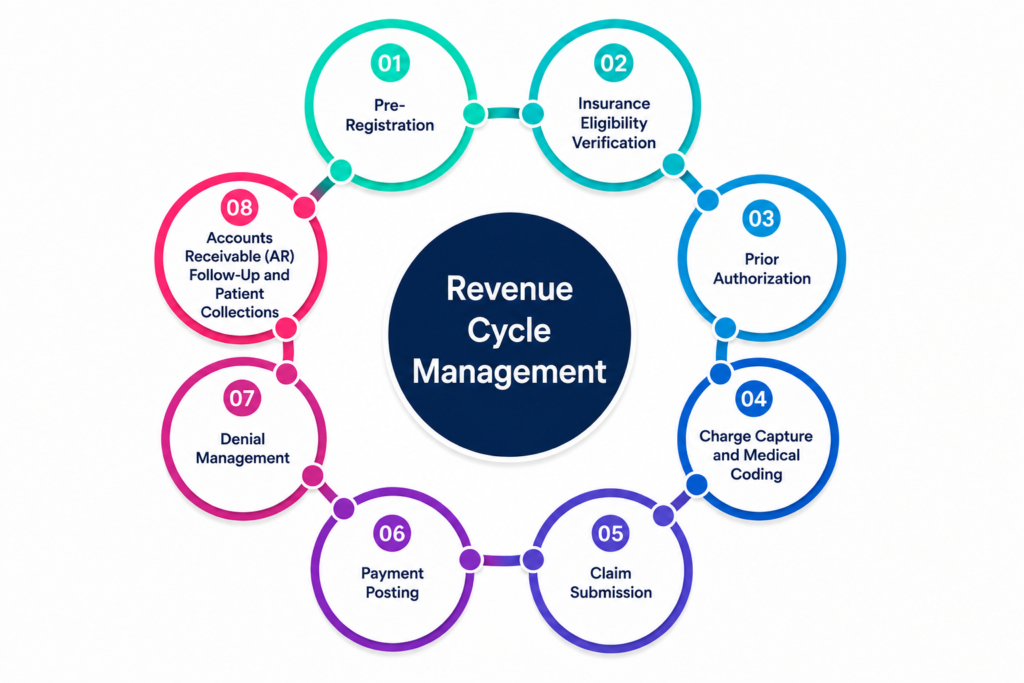
RCM isn’t a single task; it’s a sequence of connected steps. If a problem occurs at any stage, it causes delays or losses later and impacts the overall revenue cycle.
Stage 1: Pre-Registration
The process of collecting basic information of a patient, including name, date of birth, address, insurance plan, and the reason for their visit before patient arrival, is called pre-registration.
Any error in this stage causes claim rejection and you won’t find out until weeks after the visit.
Best Practice: Use an online patient portal or intake form so patients can enter their own information before arriving. This reduces data entry errors and saves your front desk staff time.
Stage 2: Insurance Eligibility Verification
Once you have the patient’s insurance information, your team needs to verify it before the appointment.
Eligibility verification means confirming:
- Is the patient’s insurance policy currently active?
- Is your practice in-network with their insurer?
- What is their deductible, and how much of it have they met?
- What is their copay and coinsurance for this type of visit?
- Does this service require prior authorization?
Skipping this step is one of the most expensive mistakes a practice can make.
If you want to understand how front-end steps like eligibility verification connect to back-end billing, see our detailed breakdown: Front-End vs Back-End Medical Billing
Stage 3: Prior Authorization
Certain procedures, tests, and medications require the insurance company’s approval before they are performed. This is called prior authorization or prior auth.
If you perform a service without getting prior authorization, even if it’s medically necessary, the insurance company can deny the claim entirely. The patient is then responsible for the full cost, which creates conflict and bad debt for your practice.
Stage 4: Charge Capture and Medical Coding
After the patient is seen, the physician documents everything that happened during the visit, including the diagnosis, the treatment, the tests ordered, and the procedures performed. The billing team then converts that documentation into standardized medical codes. Common medical billing codes specified by the industry include:
- ICD-10 (diagnosis codes)
- CPT (procedure codes)
- HCPCS codes (supplies/services)
Incorrect codes are the single most common cause of claim denials. Even a small mistake like using an outdated ICD-10 code or choosing a code that doesn’t match the documented diagnosis will cause a rejected or denied claim.
Did You Know? Upcoding (billing for a more expensive service than was provided) and undercoding (billing for less than was done) are both problems. Upcoding is considered fraud. Undercoding means leaving money on the table. Accurate coding protects you legally and financially.
Stage 5: Claim Submission
Once the claim is coded, it gets submitted to the insurance company, mostly electronically through a clearinghouse. The clearinghouse is like a quality checkpoint that checks the claim for obvious errors before passing it on to the payer.
A claim that passes through the clearinghouse without errors is called a clean claim. The goal is for every single claim to be clean on the first attempt because clean claims get paid faster with no rework required.
The challenging thing is the timely filing deadlines. Each insurance company has a specific time limit within which you must submit a claim after the date of service. Medicare’s standard window is 12 months. Some commercial payers allow only 90 days. Missing this deadline can cause a claim to be denied.
Want to understand exactly what makes a claim clean and how to improve your clean claim rate? See: How Clean Claims Improve Reimbursement Rates
Stage 6: Payment Posting
When the insurance company processes your claim, they send back an Explanation of Benefits (EOB) or Electronic Remittance Advice (ERA) detailing what they paid, what they adjusted, and what the patient owes. Your billing team then posts these payments to your practice management system. This step is important for two reasons:
- It keeps your accounts receivable accurate, so you always know what’s still outstanding
- It helps you spot underpayments when a payer reimburses you less than your contracted rate
Stage 7: Denial Management
Denials are a reality in medical billing. Even a well-run practice will receive some denied claims. The question isn’t whether you’ll get denials, it’s how quickly and effectively you respond to them.
When a claim is denied, your team needs to find the reason, fix the issue, and resubmit it, all within the payer’s appeal window, which is typically 30–180 days, depending on the insurer.
Revenue leakage from unaddressed denials is one of the biggest financial threats to any practice. Read more: What Is Revenue Leakage in Healthcare?
Stage 8: Accounts Receivable (AR) Follow-Up and Patient Collections
Not all outstanding balances come from insurance. Once the insurance has paid its portion, the patient often owes a remaining balance, their copay, deductible, or coinsurance. Collecting that balance is the final stage of the healthcare revenue cycle.
Top RCM Challenges and How to Overcome Them
Even practices with experienced billing teams face consistent challenges. Here are the most common RCM services challenges and practical revenue cycle solutions:
Challenge 1: High Claim Denial Rates
Denials are the most visible symptom of RCM problems. When your denial rate exceeds 5%, it means something in your front-end or coding process is consistently going wrong.
- Audit your top denial reason codes, identify the top 3 and fix those first
- Implement claim scrubbing software that catches errors before submission
- Run eligibility checks the day before every appointment
Challenge 2: Slow Reimbursement (High Days in AR)
Long reimbursement cycles create cash flow problems that can make it difficult to cover payroll, buy supplies, or invest in the practice.
- Submit claims within 24–48 hours of the patient visit, don’t delay it
- Track your AR aging report weekly, not monthly
- Assign specific AR accounts to specific staff members for accountability
Challenge 3: Keeping Up with Coding Changes
ICD-10, CPT, and HCPCS codes are updated annually. Using outdated codes leads to immediate denials and potential compliance issues. To resolve this issue:
- Schedule annual coding training for all billing staff
- Subscribe to updates from CMS (Centers for Medicare & Medicaid Services)
- Use billing software that automatically updates code sets
Challenge 4: Patient Collections
As high-deductible health plans become more common, patients are responsible for a larger portion of their bills. Collecting from patients is fundamentally different from collecting from insurance companies.
- Verify benefits and estimate patient responsibility before the visit
- Collect copays and known deductibles at the time of service
- Offer easy payment options like an online portal, payment plans, and automatic payment
- Send statements within 7 days of the visit while the appointment is still fresh
Challenge 5: Staff Turnover
Sometimes ignored but has a great impact on revenue. When an experienced biller leaves, your claims go unsubmitted, denials remain unworked, and AR ages rapidly.
- Document your billing processes so knowledge is stored in a system, not just people
- Cross-train staff so that no single person is the only one who knows a process
- Consider outsourcing as a way to eliminate this vulnerability entirely
How Technology Improves Revenue Cycle Management Efficiency
With the growing trends in all fields, RCM services have also changed. Now, medical billing is not about bundles of paper forms, manual data entry, and weeks of waiting. Each step of the healthcare revenue cycle has changed and become faster, more accurate, and less dependent on staff members doing everything by hand, with the help of technology. Let’s show you how technology has transformed RCM:
Automated Eligibility Verification
Instead of calling insurance companies one by one, modern billing software automatically checks patient eligibility in real time, often the night before the appointment. Your front desk team arrives in the morning knowing which patients have active coverage, what their copays are, and whether prior authorization is needed. Fewer surprises mean fewer denied claims.
AI-Powered Claim Scrubbing
Before a claim is submitted to the payer, AI-driven scrubbing tools scan it for errors like wrong codes, missing modifiers, mismatched diagnosis-procedure combinations, and more. These tools find mistakes in seconds that used to take experienced billers hours to spot. The result is a dramatically higher clean claim rate and faster reimbursement.
Electronic Remittance Advice and Auto-Posting
When insurers process claims, they send back an Explanation of Benefits (EOB). Modern RCM systems receive these as Electronic Remittance Advice (ERA) files and automatically post payments to the correct patient accounts. This reduces payment posting time from hours to minutes and reduces human error significantly.
Denial Management Dashboards
Instead of manually tracking denied claims on spreadsheets, today’s RCM platforms give billing teams a live dashboard showing every denial, its reason code, its age, and who is responsible for working it. So nothing is missed here because everything is visible and assigned.
Patient Payment Portals
Online payment portals let patients view their bills, set up payment plans, and pay from their phone, at any time of day. Practices that offer digital payment options collect patient balances faster than those relying on paper statements alone. It is more convenient for the patient and better for your cash flow.
Revenue Cycle Analytics and Reporting
Modern RCM platforms generate detailed reports on all your key metrics — Days in AR, denial rates, collection rates, payer performance, and more. Instead of guessing why revenue is down this month, you can see exactly which payer is causing problems, which codes are getting denied most often, and where AR is aging.
Revenue Cycle Management Metrics Every Practice Should Track
There are some numbers that tell you whether your revenue cycle is healthy or if you are missing some opportunities.
You do not need to track dozens of metrics. Focus on these eight numbers, review them monthly, and compare them to the industry benchmarks. These medical revenue cycle management metrics include:
- Days in AR: under 35
- Clean Claim Rate: above 95%
- Denial Rate: below 5%
- AR Over 90 Days: under 15% of total AR
- Net Collection Rate: above 95%
- First-Pass Resolution Rate: 90% or higher
- Bad Debt Rate: under 3%
- Cost to Collect: under 4%
Track these metrics in a simple monthly dashboard. The goal is to find trends early. A denial rate that crosses from 4% to 7% over three months is a warning sign. Finding it at month two is far easier than fixing it at month six.
For a complete breakdown of each metric and step-by-step tips to improve it: Top Revenue Cycle KPIs Every Practice Should Track
How M&M Claims Care Professional Medical Billing Services Help Your Practice
For healthcare providers, it’s not easy to manage patients as well as billing tasks at the same time. That’s why more providers prefer outsourced medical billing services.
At M&M Claims Care, we have worked with practices that were losing thousands of dollars a month to billing errors they did not even know about. We have helped practices reduce their denial rates in half, reduce Days in AR from 60+ days to under 30, and recover revenue that had remained in denied-claim limbo for months.
With years of experience in revenue cycle management services, we help practices to maintain a healthy revenue cycle.
- We take complete responsibility from eligibility verification before the visit to AR follow-up after payment.
- Our team includes CPC-credentialed medical coders with specialty-specific expertise across family practices, cardiology, orthopedics, mental health, physical therapy, and more.
- We consistently achieve a 99% clean claim rate for our clients. That means virtually every claim we submit is accepted by the payer on the first attempt without any delays.
- Every denied claim is reviewed, corrected, and resubmitted within your payer’s appeal window. Most practices we partner with see denial rates drop within the first 60 to 90 days.
If your practice is dealing with revenue leakage, high denial rates, or slow cash flow, our experienced team is here to help.
Just contact us at +1 (267) 768-7915 and discover how a smarter revenue cycle strategy can improve your practice’s financial performance and long-term growth.