Every medical practice in the country fights for the same thing: that their claims get submitted on time, stay updated with payers, and, in the end, receive expected revenue. But when they face denials, reworked claims cost them a lot.
These are challenges that practices have faced for years. But with the rise of artificial intelligence, many of these long-standing challenges can now be addressed with smarter, faster, and more efficient solutions. That’s why recent industry surveys show that a majority of healthcare organizations now use AI somewhere in their revenue cycle, most commonly for eligibility verification, claim scrubbing, and denial prediction.
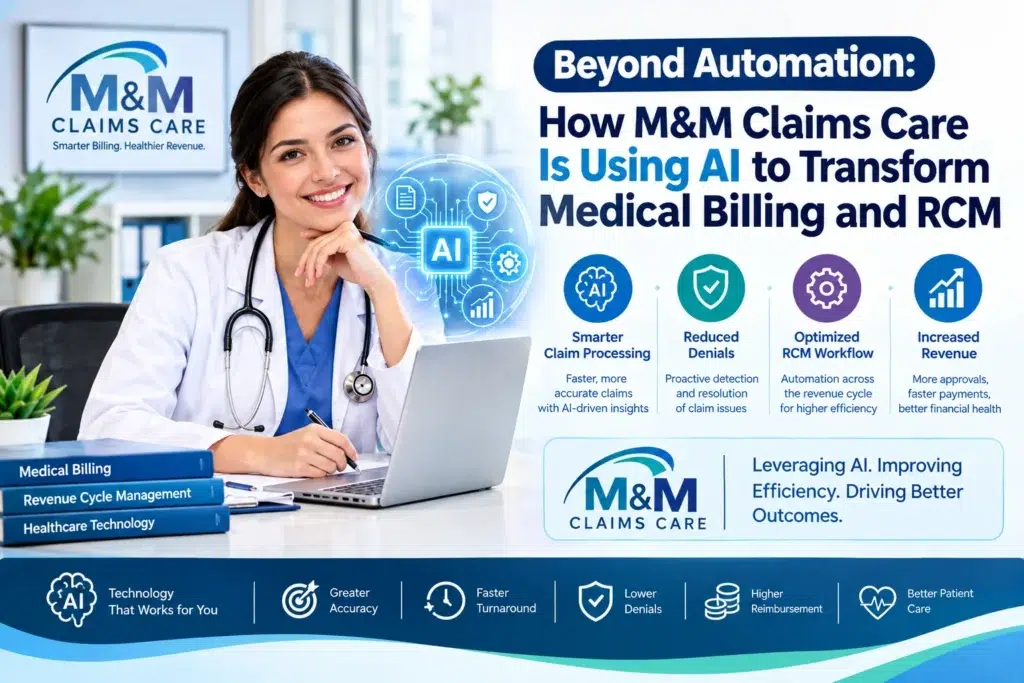
Why should M&M Claims Care be left behind when we always stay updated with the latest technology? We combine AI with experienced human billers to handle claims, denials, and payer decisions effectively. Let’s show you how AI is really doing in medical billing and RCM in 2026.
Why AI in Medical Billing Is Suddenly Everywhere
Three main factors are pushing AI into revenue cycle management (RCM):
Denials are increasing, not decreasing.
Many denials are caused by simple administrative and eligibility mistakes rather than medical necessity issues. Common examples include a wrong date of birth, an outdated insurance ID, or a missing prior authorization number. These are rule-based and repetitive errors, which makes them best for AI. Machine learning can help find these mistakes before a claim is submitted.
Payers are already using AI.
Many insurance companies now use AI to review claims and identify potential problems. Doctors are noticing the impact too, with many reporting that claim denials have increased in recent years. When payers use automated systems, billing teams that still depend heavily on spreadsheets and manual corrections can struggle to keep up.
AI technology has become more useful.
AI can now review clinical notes and suggest ICD-10, CPT, and HCPCS codes. Machine learning can also identify claims that have a high risk of denial before they are submitted. Automation can check patient eligibility and benefits in real time instead of relying on slower manual processes. Since administrative work and claim rework cost the U.S. healthcare system hundreds of billions of dollars each year, AI can help reduce some of this unnecessary work.
Simply put, healthcare practices using older, mostly manual billing processes are now dealing with insurance companies that use much more advanced technology. AI in RCM helps close that technology gap by making billing faster, more accurate, and more efficient.
What AI Actually Does in Modern Medical Billing
AI-powered billing can sound complicated but it simply means using AI to handle or support specific tasks throughout the billing process.
Eligibility & Benefits Verification
AI tools can check a patient’s insurance information in real time before the visit. They can find coverage issues, plan changes, and benefit limits that could later cause a claim denial. If the patient’s coverage changes, the system can check it again.
Computer-Assisted Coding
AI can review the provider’s notes and suggest the correct ICD-10, CPT, and HCPCS codes. It can also identify possible modifiers and coding issues. AI does not replace certified coders. Instead, it gives them a faster and more consistent starting point and helps reduce coding errors.
Claim Scrubbing
Before a claim is submitted, AI can check it for common errors. These include incorrect diagnosis and procedure codes, missing modifiers, wrong place-of-service codes, or formatting problems. Finding these errors before submission is much easier than fixing them after a denial.
Predictive Denial Analytics
AI can review past claims and identify claims that are at high risk of denial. It can also point out possible reasons, such as missing authorization, frequency limits, or coding conflicts. Billing teams can fix these issues before submitting the claim instead of dealing with them later.
Payment Posting & Reconciliation
AI can match electronic remittance advice (ERA) to the correct claims and help post payments and adjustments automatically. It can also identify payment differences that need human review. This reduces the amount of manual data entry for billing teams.
Patient Financial Communication
AI can help identify patient accounts that are less likely to pay their balances. It can then support earlier reminders, personalized messages, or payment-plan options. This can help practices improve patient collections without using the same approach for every patient.
Overall, AI can reduce manual work, find billing errors earlier, and help improve claim acceptance and A/R performance. But results can vary depending on the practice, payer mix, and how the technology is used. The important thing is not simply to use AI, but to use it in the right parts of the billing process.
What AI Can't Replace in Medical Billing
This is an important part of using AI in medical billing. AI can handle many tasks but it cannot replace human judgment in every situation.
- AI can’t make medical-necessity decisions. It can identify patterns that look similar to past denials but it cannot fully understand a patient’s unique medical situation like a trained reviewer or physician can.
- AI can’t take responsibility for compliance decisions. If a claim is coded incorrectly and later audited as AI suggested it does not protect the practice. A qualified professional still needs to review and take responsibility for the decision.
- AI can struggle with unusual cases. Complex payer situations, detailed appeals, narrative letters, and special contract terms need human knowledge and experience. These are situations where experienced billing specialists are still important.
- AI depends on accurate data. If the system uses outdated payer rules or incorrect information, it can produce incorrect results. AI can work quickly but it can also repeat the wrong information just as quickly.
The practices seeing the most value from AI are not relying completely on AI or avoiding it altogether. They are using a hybrid approach which is the best. AI handles repetitive and high-volume tasks while experienced billers handle situations that require judgment, communication, negotiation, or accountability.
That is the approach M&M Claims Care follows, using AI where it adds value while keeping experienced human billers involved when human judgment is needed.
The Compliance Risks of Using AI in RCM
Many articles about AI in medical billing leave out that AI used in healthcare billing and utilization review is becoming more regulated and the rules are changing quickly.
- CMS-0057-F (the Interoperability and Prior Authorization Final Rule) started taking effect in 2026. It requires certain health plans, including Medicare Advantage, Medicaid, CHIP, and ACA Marketplace plans, to respond to expedited prior authorization requests within 72 hours and standard requests within 7 calendar days. Payers must also provide a specific reason when they deny a request. Full electronic prior authorization through APIs is required by January 1, 2027.
- CMS’s WISeR model began in selected states in 2026. It is testing the use of AI-assisted technology to review certain Medicare fee-for-service prior authorization requests. This shows how automated review is becoming part of the healthcare system.
- Several states are also creating new AI rules. Laws and regulations in states such as Washington, Maryland, Indiana, Utah, Georgia, and Alabama address the use of AI in healthcare decisions. Some restrict AI from being the only reason for denying or delaying care and require human review of certain adverse decisions.
Why This Matters for Medical Practices
If you are choosing an AI-powered billing company, you need to know how its system works and who reviews its decisions. A system should be able to keep an audit trail and show when a qualified human reviewed an important claim, coding decision, or appeal.
This is why M&M Claims Care uses human review as an important part of its AI-assisted billing process. AI can identify errors, coding issues, and denial patterns, but an experienced biller or coder reviews these findings before they affect a patient’s account or a practice’s billing and compliance records.
AI can support the billing team but human oversight remains essential when a decision requires professional judgment and accountability.
How Other RCM Companies Are Using AI
It is helpful to know what medical billing businesses are really providing in order to conduct a fair comparison. AI is now used by many major national RCM firms.
- AI claim scrubbing: Many companies use in-house systems to check claims for payer-specific errors before submission. Some report first-pass claim acceptance rates in the high 90% range.
- AI-assisted coding: Some companies use AI to review clinical documentation and suggest diagnosis and procedure codes. They also provide dashboards that help track denial trends by payer and provider.
- Predictive denial scoring: Many companies use past claims data to find claims that can be at higher risk of denial. This helps billing teams to fix potential problems before submitting the claim.
These are helpful AI features that can speed up and improve the accuracy of billing. But another important topic is where AI ends and humans take control.
Many companies provide limited information about when a human reviews or overrides an AI recommendation. Practices also need to know whether the billing process keeps proper records that can support an audit or regulatory review.
That’s why M&M Claims Care focuses on its approach. Our goal is not just to use more AI. It is to have a clear and documented process showing when an experienced human biller reviews, corrects, or overrides an AI recommendation.
AI handles repetitive work while human experts remain connected when judgment, correction, or accountability is required.
How M&M Claims Care Applies AI Across the Revenue Cycle
Our RCM approach was based on the basic idea that AI should help with billing rather than eliminate human accountability. Let’s show how we work:
- Front-end verification: We check patient eligibility and benefits in real time before the appointment. It helps us prevent problems before a claim is submitted.
- Coding support with human review: AI can suggest codes based on clinical documentation but our certified coders review and approve them. They can find details and context that AI can miss.
- Pre-submission claim scrubbing: Every claim is checked for payer-specific requirements before submission. This helps find modifier, bundling, and formatting errors that can lead to denials.
- Alerts for denial-risk with biller review: Before submitting a claim, our billers review and make any necessary corrections when AI indicates that it is high-risk. Instead of employing a general template, a billing specialist handles claims that require an appeal depending on the particular requirements of that payer.
- Clear reporting: In one place, practices can track A/R aging, rejection trends by payer and reason, and clean-claim rates. This shows what the AI is doing and maintains process transparency.
Our specialty-specific billing services for small practices, urgent care, mental health, acupuncture, and payer enrollment are all based on the same methodology. Technology executes repetitive activities on a large scale, while qualified specialists are responsible for judgments affecting claims, payments, and compliance.